AI Regulations in Education
Scope. Extent. Oversight. Practical implications for schools.
Around the world, “AI regulation” in education is rarely a single law. It is a stack of overlapping rules that governs how AI tools can be used with learners, data, assessment, and decision-making. This page provides a country-agnostic overview of what regulations typically cover, which school uses are most sensitive, and how enforcement usually happens in practice.
What “AI regulation” usually covers in education
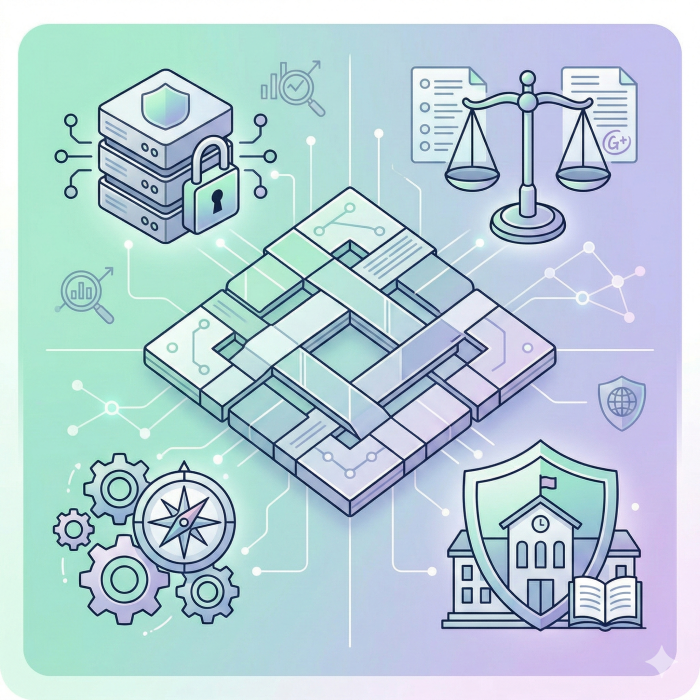
Even where there is no dedicated “AI law,” schools are regulated through multiple frameworks that become legally relevant as soon as AI systems process student data, influence high-impact decisions, or introduce new safety risks. These are the most common regulatory buckets worldwide.
Student Data Protection & Privacy
Rules on collection, purpose limits, retention, sharing, cross-border transfers, and whether data can be used to train AI models.
Children’s Online Safety & Age Safeguards
Higher protection thresholds for minors: transparency, profiling limits, parental rights, and age-appropriate design expectations.
Transparency & Disclosure
Requirements to disclose AI use (especially in student-facing interactions) and to communicate limitations, risks, and appropriate use.
Automated Decision-Making Safeguards
Controls for AI that ranks, labels, predicts, or influences high-impact outcomes (admissions, placement, grading, discipline, supports).
Non-Discrimination, Equity & Accessibility
Expectations to prevent biased outcomes, monitor disparate impact, and ensure AI-enabled services remain accessible and fair.
Security, Safety & Incident Readiness
Cybersecurity controls, access management, logging, incident response, and breach reporting—especially for sensitive student data.
Content Integrity & Synthetic Media
Policies and, increasingly, rules about AI-generated content: labeling, misinformation, impersonation, deepfakes, and safeguarding.
Vendor Claims, Procurement & Accountability
Schools are expected to do due diligence: contracts, security posture, evidence of limitations, and avoiding reliance on marketing claims.
Unifying principle: the closer an AI system is to a high-stakes impact on a learner (admissions, placement, grading, discipline, sensitive monitoring), the stricter the legal expectations become. Lower-stakes classroom use is typically easier to manage—provided privacy, safety, and transparency are respected.
Which school uses are most legally sensitive?
Across jurisdictions, scrutiny escalates when AI is used to classify, rank, predict, or monitor students in ways that could shape opportunities, wellbeing, or rights. These use cases routinely require the strongest governance.
- Admissions & placement — screening, ranking, assignment
- Assessment & grading — scoring, progression decisions
- AI proctoring — exam monitoring, misconduct flags
- Profiling & prediction — “at-risk” labels, pathway recommendations
- Wellbeing triage — sensitive inference and safeguarding triggers
- Behavior monitoring — surveillance-like practices, biometric features
How regulation is “policed” in practice
Enforcement rarely looks like a single “AI regulator.” Oversight is usually distributed across existing bodies. Most scrutiny begins with complaints, incidents, or evidence of harm—then regulators ask for governance evidence: what tool was used, what data it processed, what safeguards existed, and how decisions were reviewed and contested.
- Data protection authorities — student privacy, data transfers, retention
- Child safety regulators — age safeguards, harmful design, tracking
- Education authorities — assessment integrity, safeguarding expectations
- Equality & rights bodies — discrimination, accessibility, due process
- Consumer protection — misleading vendor claims, harmful UX
- Cybersecurity bodies — incidents, breach response, resilience
- Courts/tribunals — appeals, disputes, accountability
Want an answer specific to your school activity?
Use the Center’s Regulatory Advisor to map your use case to likely regulatory buckets, identify high-impact risks, and generate a practical governance checklist (policies, disclosures, vendor clauses, evidence pack).