Standards for AI in Education
A practical framework for safe, ethical, and learning-centred use of AI in K–12 schools.
Artificial intelligence is reshaping how people learn, communicate, and work. In schools, AI can expand feedback,
creativity, inclusion, and efficiency—but only if it is implemented with clear boundaries, strong safeguards,
and an unwavering commitment to human development.
These Standards provide a shared language and a practical reference point for schools seeking to adopt AI in ways
that protect children, strengthen learning, and build trust with families and staff. They are designed to support
both responsible day-to-day practice and long-term institutional readiness as technologies evolve.
AI should extend human capability, not replace human judgment, relationships, or the purpose of education.
How the Standards are structured
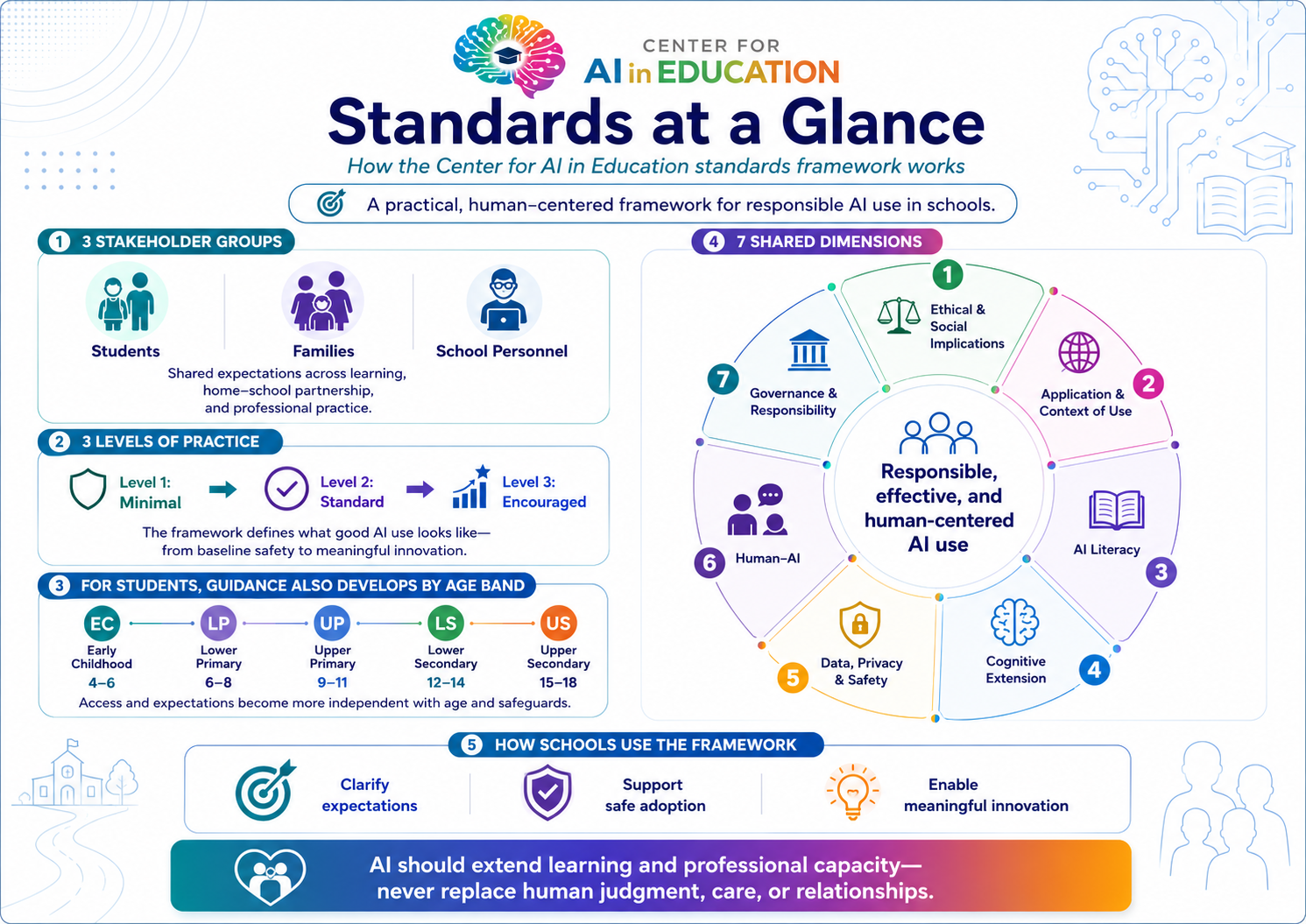
The framework is organised into seven areas, each addressing a critical dimension of AI in schools.
For each area, standards are described across three levels of maturity:
- Level 1 — Minimal Use / Foundational: tightly controlled, low-risk use; basic safeguards and clear boundaries.
- Level 2 — Standard Use / Embedded Practice: routine workflows aligned with policy, training, and consistent safeguards.
- Level 3 — Encouraged Use / Co-Designed & Innovative: high-quality, student-centred practices with reflection and continuous improvement.
Each area includes standards for Students, Families, and School Personnel.
Standards at a Glance
A visual overview of how the framework connects stakeholders, levels of practice, student age bands, and the seven standards dimensions.