AI and Energy:
What Teachers Need to Know
A balanced guide to the environmental footprint and climate potential of artificial intelligence.
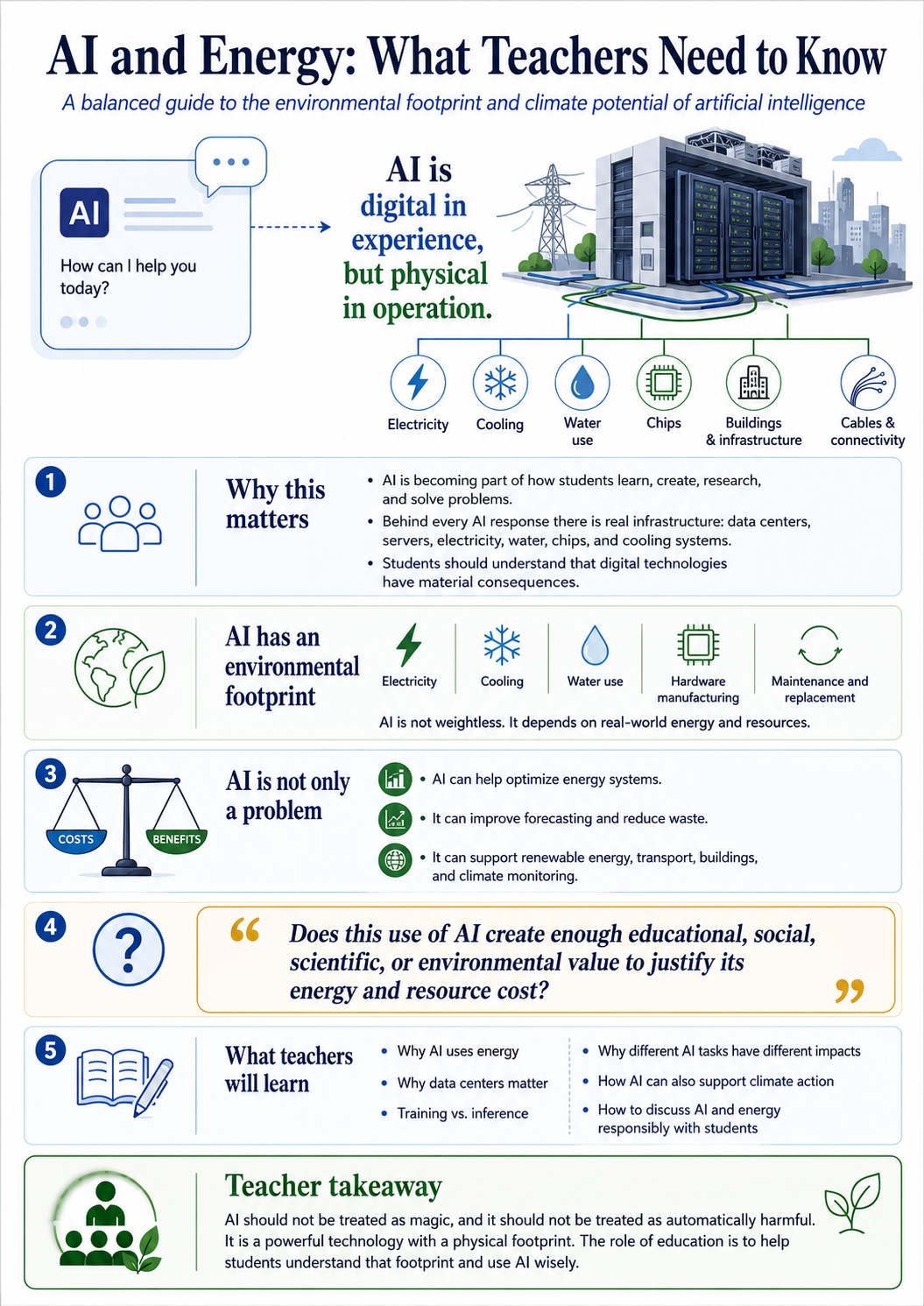
AI often feels invisible, but it is not weightless.
A student types a question, receives an answer, generates an image, translates a text, or asks for feedback in seconds. From the user’s point of view, the interaction seems almost weightless.
But behind every AI response there is a physical system: data centers, servers, chips, cooling systems, electricity grids, water infrastructure, minerals, cables, and buildings.
The “cloud” is not really a cloud.
It is a network of machines located somewhere on Earth. AI is digital in experience, but physical in operation.
AI is becoming part of how students learn, create, research, write, design, and solve problems.
If schools are going to teach students to use AI responsibly, they also need to help them understand that digital technologies have material consequences.
AI has an environmental footprint. It consumes energy. It may require water for cooling. It depends on hardware that must be manufactured, transported, powered, maintained, and eventually replaced.
At the same time, AI is not only a source of environmental pressure. It can also help reduce emissions by improving energy forecasting, optimizing buildings, supporting renewable energy systems, identifying waste, monitoring forests, improving transport flows, and helping people make better environmental decisions.
AI is neither simply a climate disaster nor automatically a climate solution.
It has costs.
AI depends on energy, water, chips, cooling, data centers, electricity grids, and material supply chains.
It can create value.
AI can help reveal waste, improve forecasting, support renewable energy, and optimize complex environmental systems.
Central question
Does this use of AI create enough educational, social, scientific, or environmental value to justify its energy and resource cost?
What teachers will learn
Understanding the footprint
- Why AI uses energy
- Why data centers matter
- How water, cooling, chips, and infrastructure are involved
Understanding different uses
- Training vs. inference
- Text, image, video, and agentic uses
- Why different tasks have different impacts
Understanding the broader system
- Local grids and infrastructure
- Energy use vs. carbon impact
- The limits of efficiency alone
Understanding the educational role
- How AI can support climate action
- How to discuss AI and energy responsibly
- How to build student judgment
Teacher takeaway
AI should not be treated as magic, and it should not be treated as automatically harmful. It is a powerful technology with a physical footprint. The role of education is to help students understand that footprint, evaluate the value of different uses, and develop the judgment needed to use AI wisely.
Continue to Section 2: Why Teachers Need to Understand AI and Energy
The next section connects AI and energy to digital citizenship, environmental literacy, school life, and responsible classroom discussion.
Go to Section 2 →