Explore the Curriculum Section
The Curriculum section of the Center for AI in Education has been designed as a coherent K–12 pathway rather than a loose collection of resources. This tour offers a guided look at its structure, its developmental logic, and the way it connects conceptual clarity with practical implementation.
A guided walk through the full K–12 curriculum pathway
As you move through this section, you will see how the curriculum begins with foundational human-centred thinking, develops through guided and supervised use, expands into multimodal creation and workflow design, and culminates in advanced reflection on ethics, creativity, accountability, and the future of work.
The Curriculum Hub
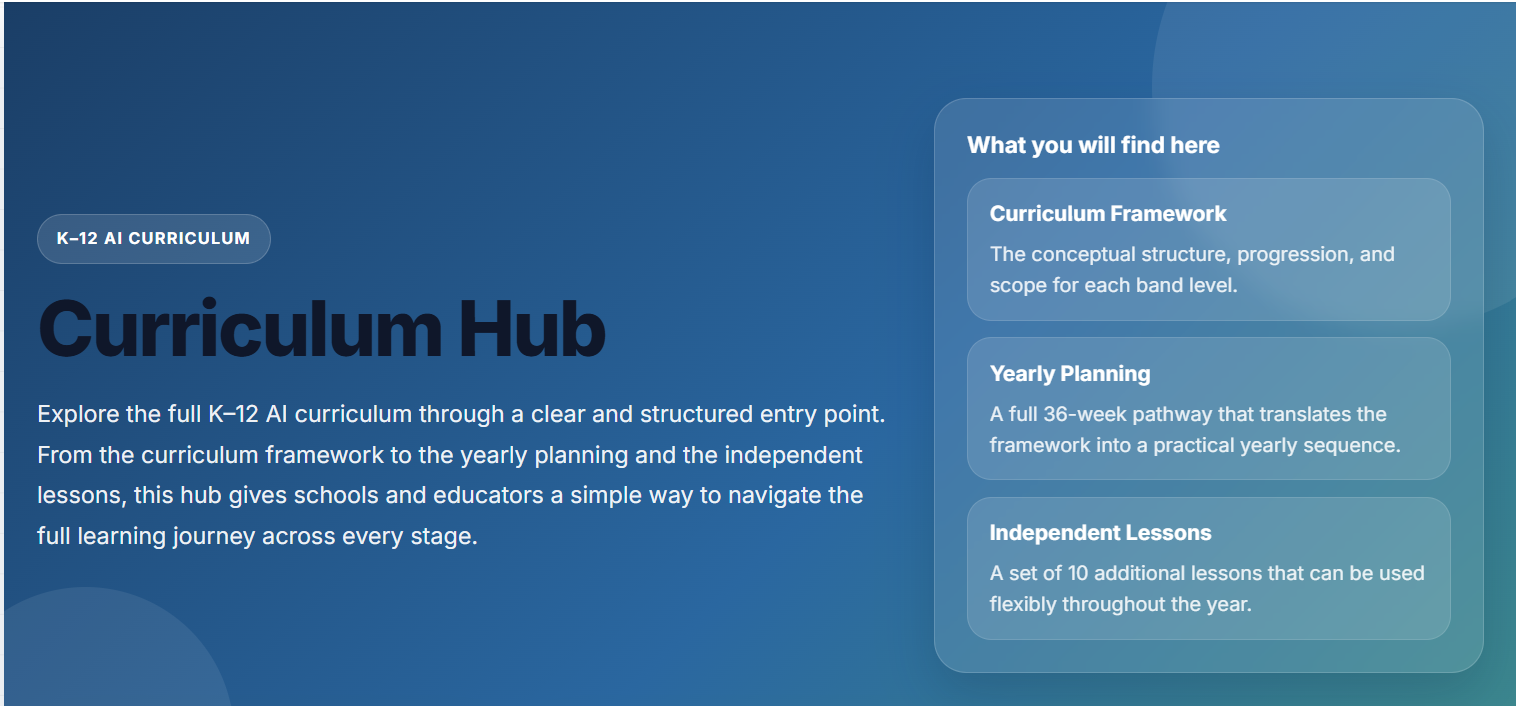
The Curriculum Hub is the central entry point to the K–12 AI Curriculum. It brings together the major components of the curriculum in one place and helps educators and school leaders understand how the full learning journey is organized.
Rather than asking visitors to move across separate pages without context, the hub offers a clear overview of the entire structure. From here, users can enter the conceptual framework, explore the year-long planning sequence, or access flexible independent lessons.
Three parts of one coherent pathway
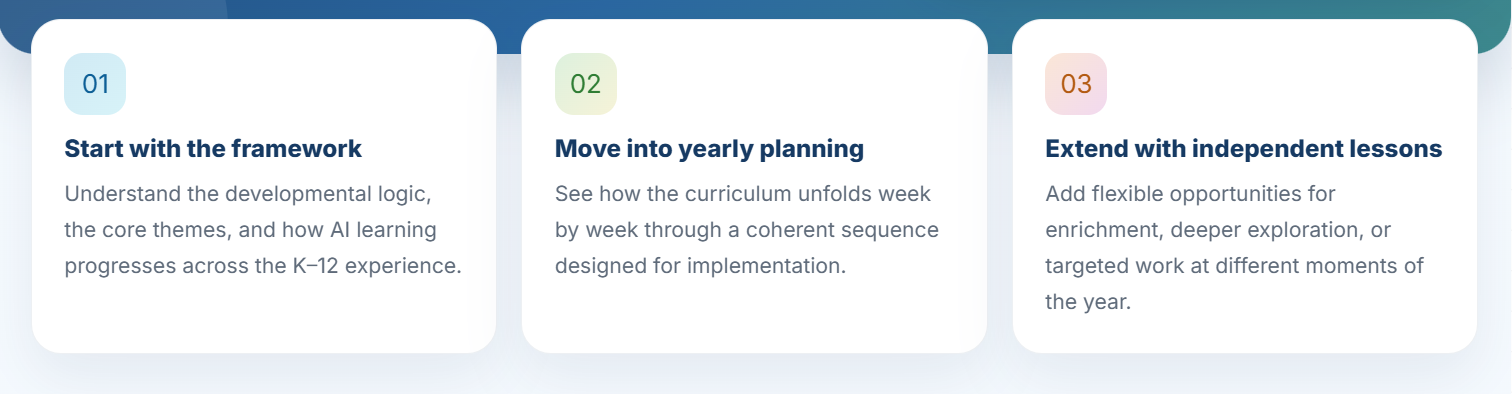
The curriculum is organized into three connected layers. The first is the Curriculum Framework, which explains the educational logic, the scope of learning, and the progression across stages. The second is Yearly Planning, which translates that logic into a practical 36-week implementation pathway. The third is Independent Lessons, which provide flexible lesson-level resources aligned to the larger progression.
Together, these three layers create a curriculum that is both conceptually robust and practically usable. Schools can begin with the big picture, move into implementation, and extend or adapt their work through targeted lessons.
Organized by developmental band
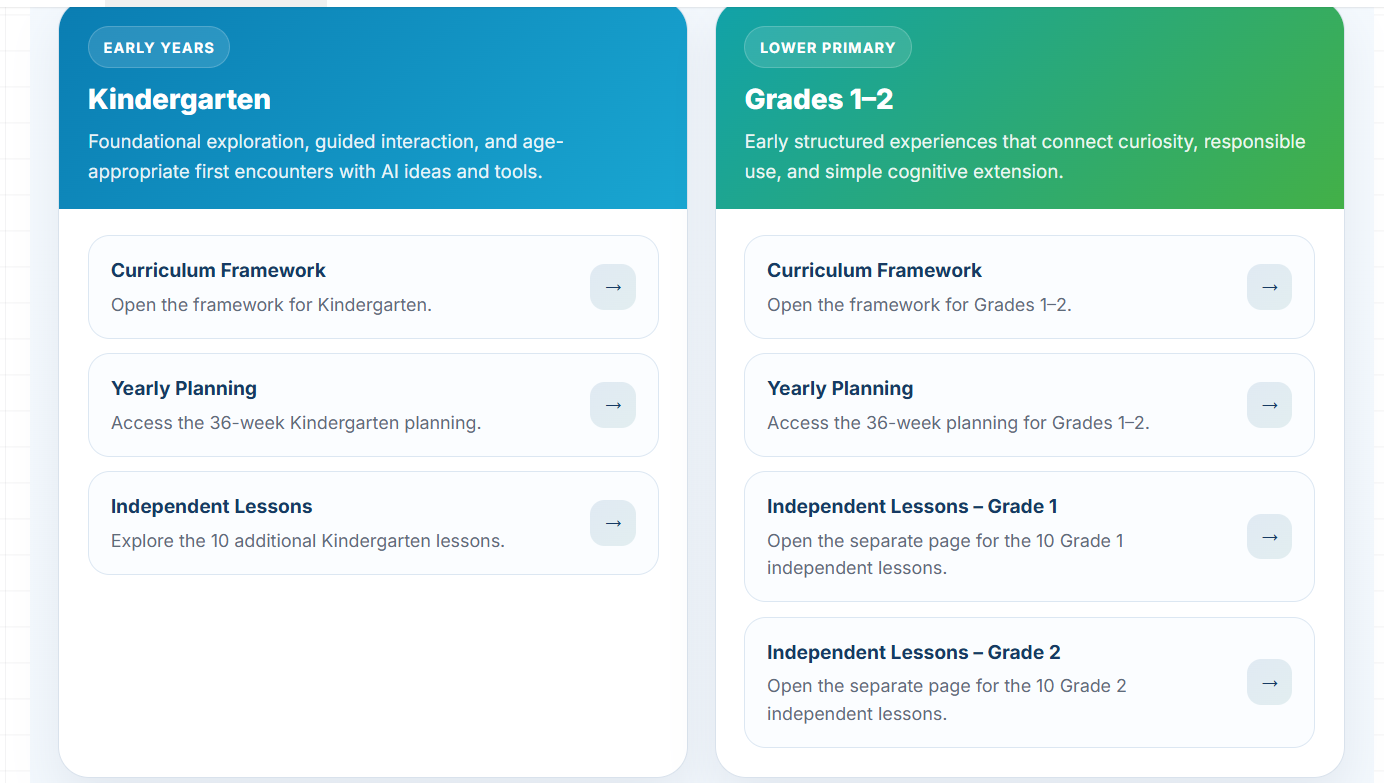
The Curriculum section is organized by developmental band, beginning in Kindergarten and continuing through Grades 11–12. Each band gives access to its framework, planning materials, and related lessons, allowing educators to focus on what is appropriate for a given age range while still seeing the larger K–12 progression.
This structure reinforces one of the curriculum’s most important principles: AI learning should not be treated as a generic set of skills taught the same way to everyone. It should evolve with the learner’s age, maturity, cognitive readiness, and ethical capacity.
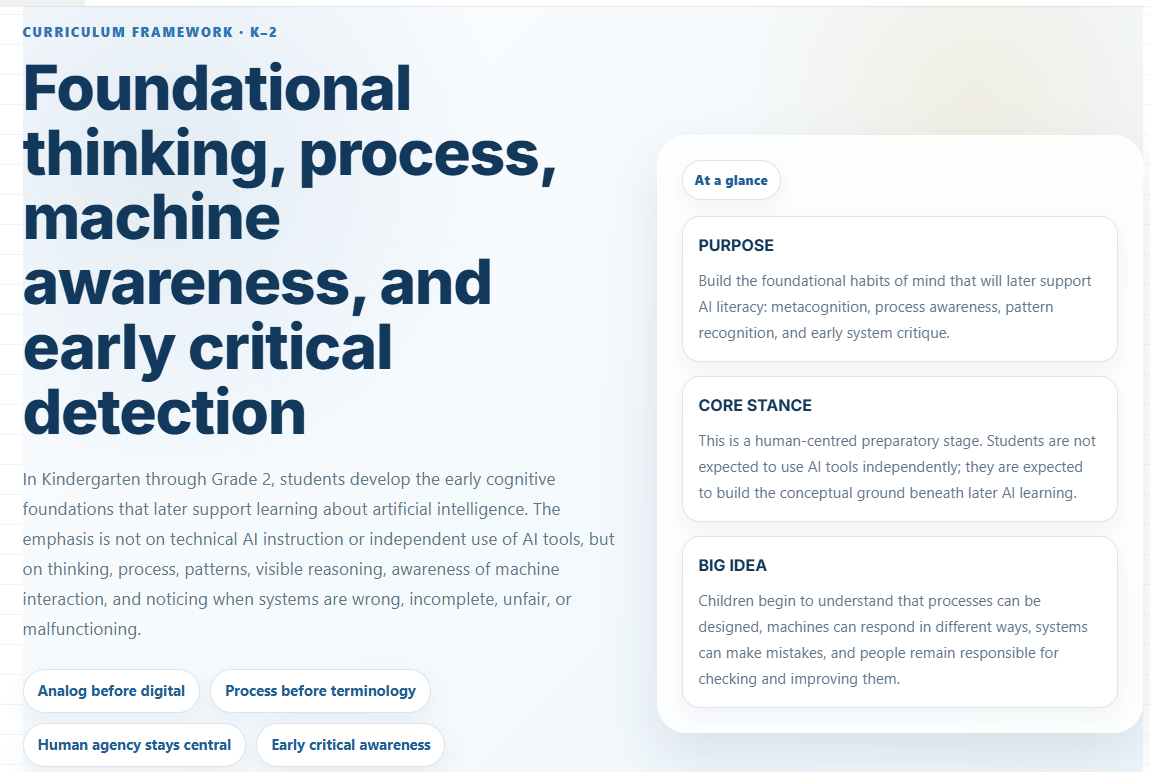
K–2: Human-centred foundations
In the earliest years, the curriculum focuses on foundational habits of thinking rather than on technical AI use. Students explore process, sequence, pattern, visible reasoning, and simple interaction with systems and machines. They also begin to notice when something works, when it does not, and when a human being needs to check, revise, or improve a response.
This stage is intentionally human-centred. It introduces ideas that will later support AI literacy, but without rushing children into tool-based or abstract instruction. The emphasis is on preparation: building the habits of mind that will make later AI learning meaningful and developmentally appropriate.
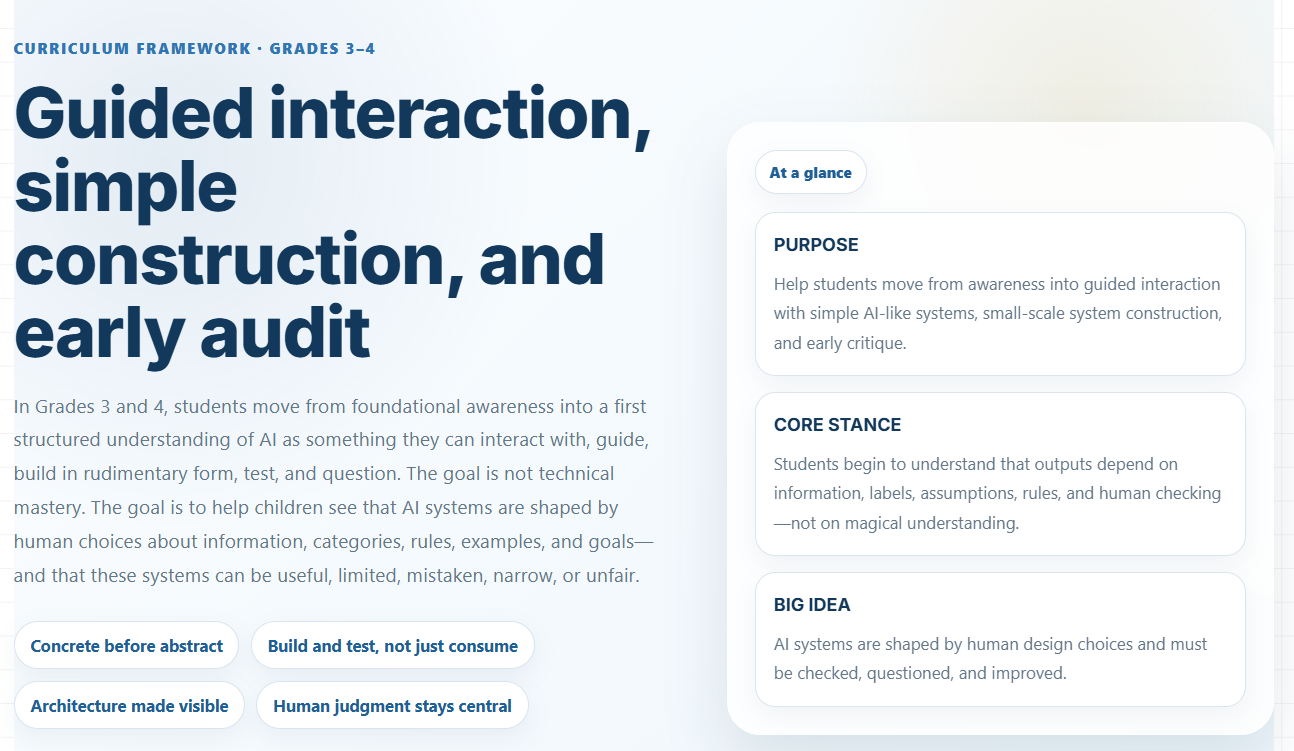
Grades 3–4: Early system understanding
In Grades 3 and 4, students begin to move from general awareness into a first explicit understanding of how AI-related systems work. They encounter the idea that systems depend on categories, examples, rules, information, and human decisions. They also begin to see that such systems can be useful, but also limited, mistaken, or unfair.
At this stage, the curriculum encourages guided interaction and simple construction. Students start to understand that outputs do not appear magically. They emerge from choices made by people, from structures built into systems, and from the quality of the information those systems receive.
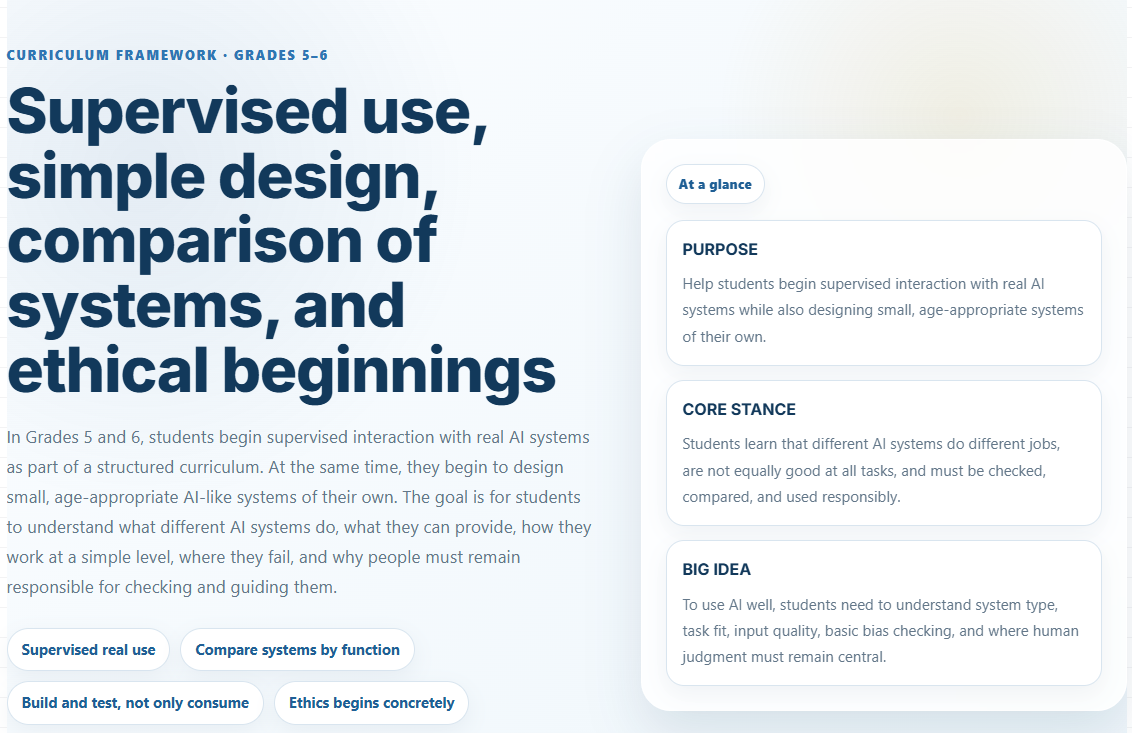
Grades 5–6: Supervised real use and ethical beginnings
In Grades 5 and 6, the curriculum introduces supervised direct interaction with real AI systems. Students begin comparing different kinds of AI tools by purpose and function. They refine prompts, evaluate results, and start building simple systems of their own. At the same time, they begin to discuss issues such as fairness, privacy, originality, permission, and responsibility.
This is an important turning point. Students are no longer only learning about systems conceptually. They are beginning to work with them directly, but always within a carefully guided environment. The curriculum makes clear that using AI is not enough. Students must also learn when it is appropriate, how it should be checked, and what parts of the work should remain human.
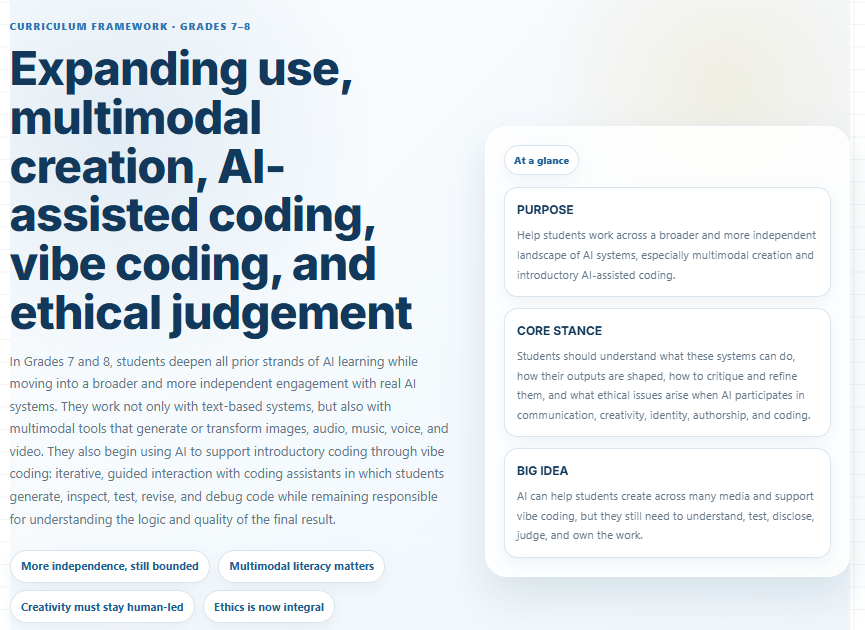
Grades 7–8: Multimodal creation and AI-assisted workflows
By Grades 7 and 8, the curriculum broadens considerably. Students begin engaging with a wider ecosystem of tools, including systems that support multimodal creation such as text, image, audio, and coding-related environments. The curriculum also introduces AI-assisted coding and vibe coding, while insisting that students remain responsible for understanding, testing, and improving what is produced.
This stage places strong emphasis on authorship, disclosure, consent, and judgment. As AI systems become more capable and expressive, the curriculum responds by increasing the intellectual and ethical demands placed on learners.
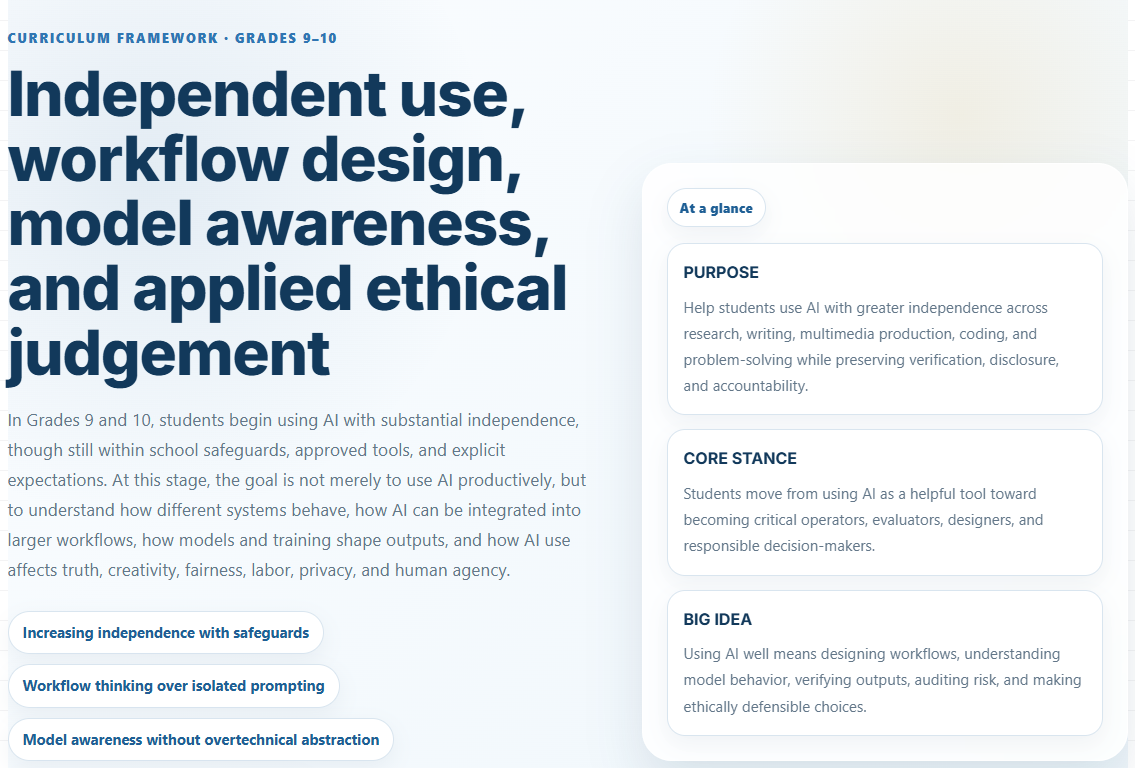
Grades 9–10: Independence, verification, and workflow design
In Grades 9 and 10, the curriculum begins to emphasize more independent use within clear safeguards. Students are encouraged to think not only in terms of prompts or isolated outputs, but in terms of full workflows. They compare systems, verify claims, examine limitations, and make decisions about tool choice, sequence, and task fit.
This reflects an important maturation in the curriculum. AI is no longer presented simply as an aid for producing outputs. It becomes part of a broader process of inquiry, creation, evaluation, and judgment.
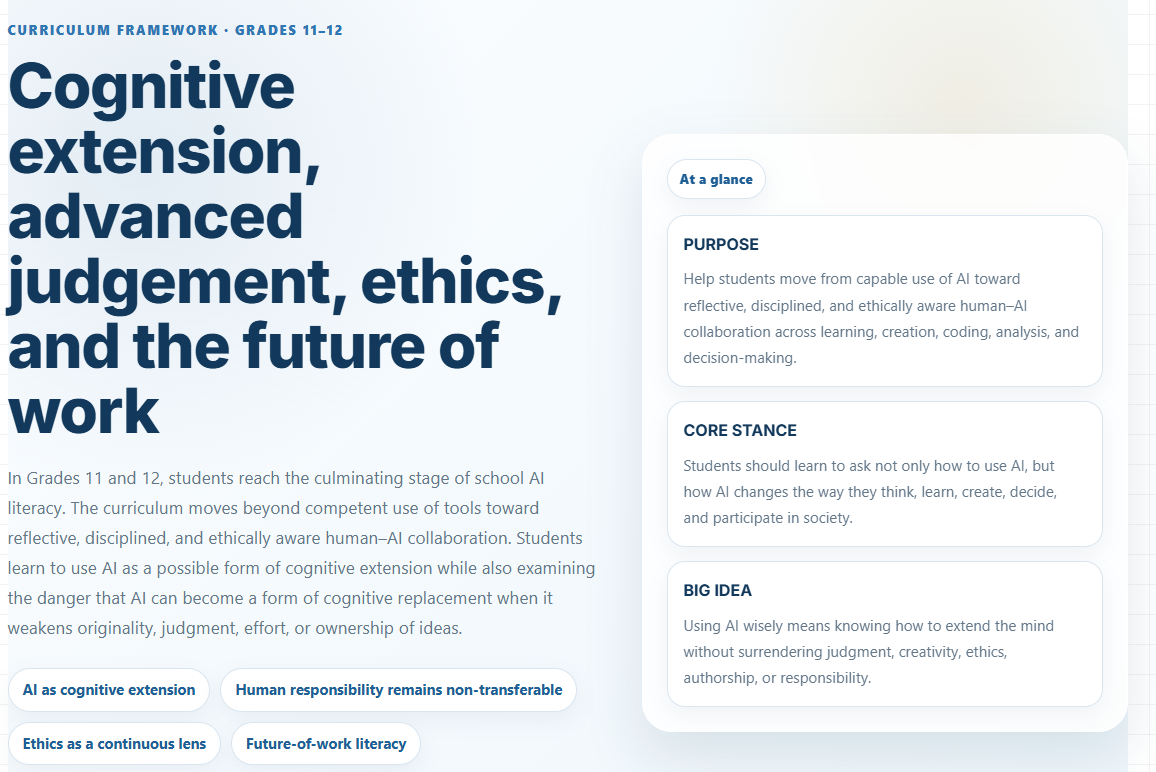
Grades 11–12: Cognitive extension and the future of work
In the final years of secondary school, the curriculum reaches its most reflective and demanding stage. Here the emphasis is on cognitive extension, advanced ethical judgment, creativity, human agency, and the future of work. Students are expected to think about how AI can extend thinking productively, but also about the risks of overdependence, diminished originality, weakened judgment, and loss of authorship.
This stage makes the deeper purpose of the curriculum fully visible. Students are being prepared not only to use AI well, but to understand how AI affects human learning, responsibility, creativity, labor, and identity.
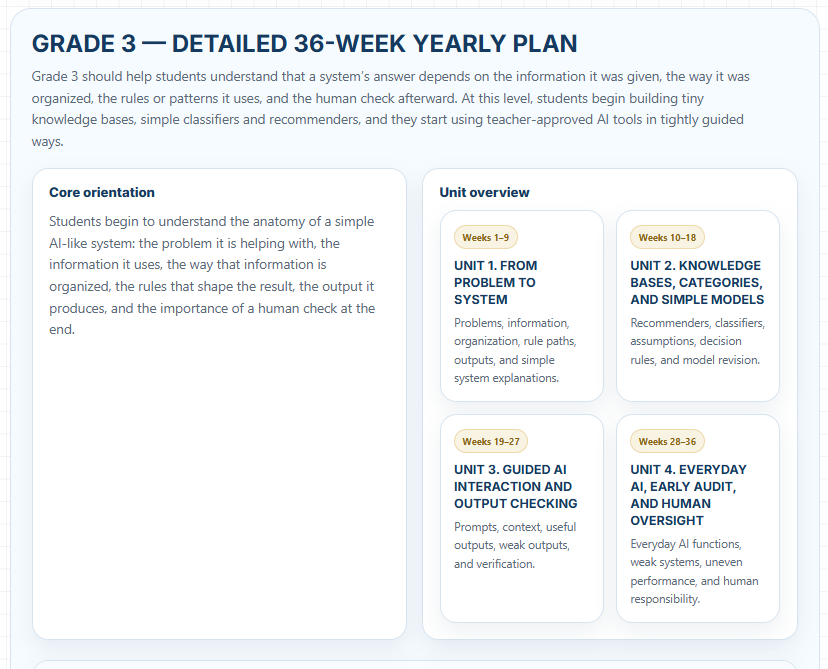
From framework to implementation
One of the distinguishing strengths of this section is that it does not stop at conceptual framing. The yearly planning pages translate the framework into a 36-week pathway, giving schools and teachers a practical structure for implementation across the academic year.
These pages show how broad ideas are turned into a sequence of units, weekly rhythms, and progressively more demanding learning experiences. The result is a curriculum that can be adopted, scheduled, and taught, rather than simply admired in principle.
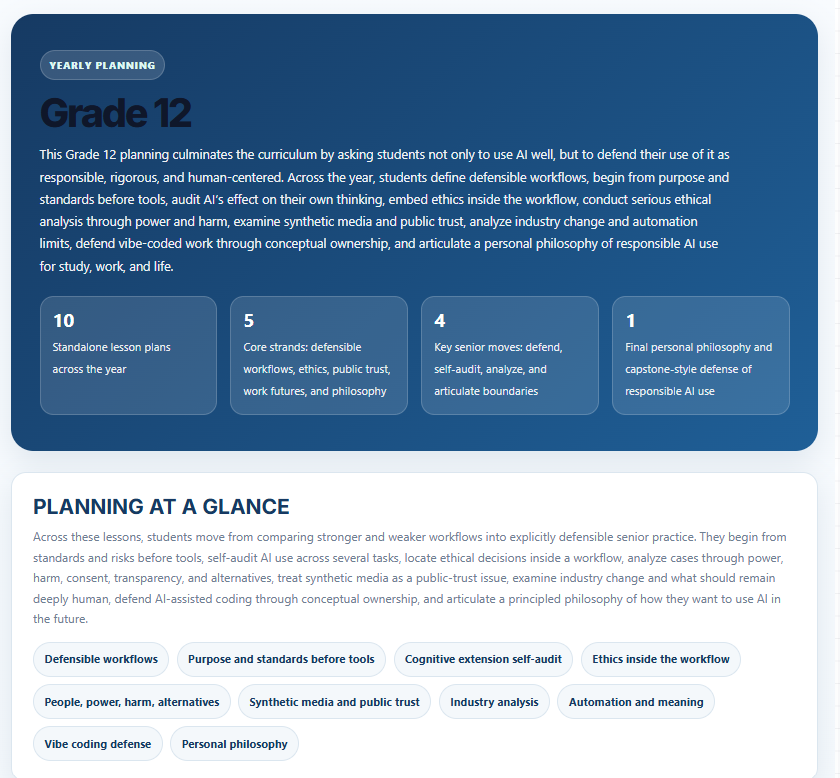
Flexible independent lessons
The Independent Lessons provide a flexible layer within the curriculum. These lessons are organized by individual grade and can be used to reinforce, extend, or complement the larger yearly sequence. Although they are more modular in form, they still reflect the same developmental philosophy and pedagogical direction as the rest of the curriculum.
This means teachers can draw on the lessons in a targeted way without losing alignment with the overall K–12 progression. The lessons support immediate classroom use while remaining connected to a larger educational vision.
The larger educational vision
Taken as a whole, the Curriculum section presents a clear vision of AI education. It begins with foundational thinking and visible reasoning, develops through guided and supervised use, expands into multimodal creation and workflow design, and culminates in advanced reflection on ethics, creativity, accountability, and the future of human work.
What makes this section distinctive is that it does not reduce AI education to technical competence alone. It treats AI as an educational, ethical, and human question. The curriculum is designed to help students grow into capable, thoughtful, and responsible people in a world where AI will increasingly shape learning, work, communication, and society.
Conceptual clarity
The framework makes the developmental logic and educational purpose of the curriculum visible.
Practical structure
The 36-week planning turns the framework into a pathway that schools can actually implement.
Flexible use
The independent lessons allow teachers to extend the curriculum while remaining aligned to the larger vision.