Inside the Standards
A guided tour of the Center for AI in Education’s Standards section — a structured framework built to help K–12 schools approach artificial intelligence with clarity, coherence, and educational purpose.
A serious framework for a serious moment
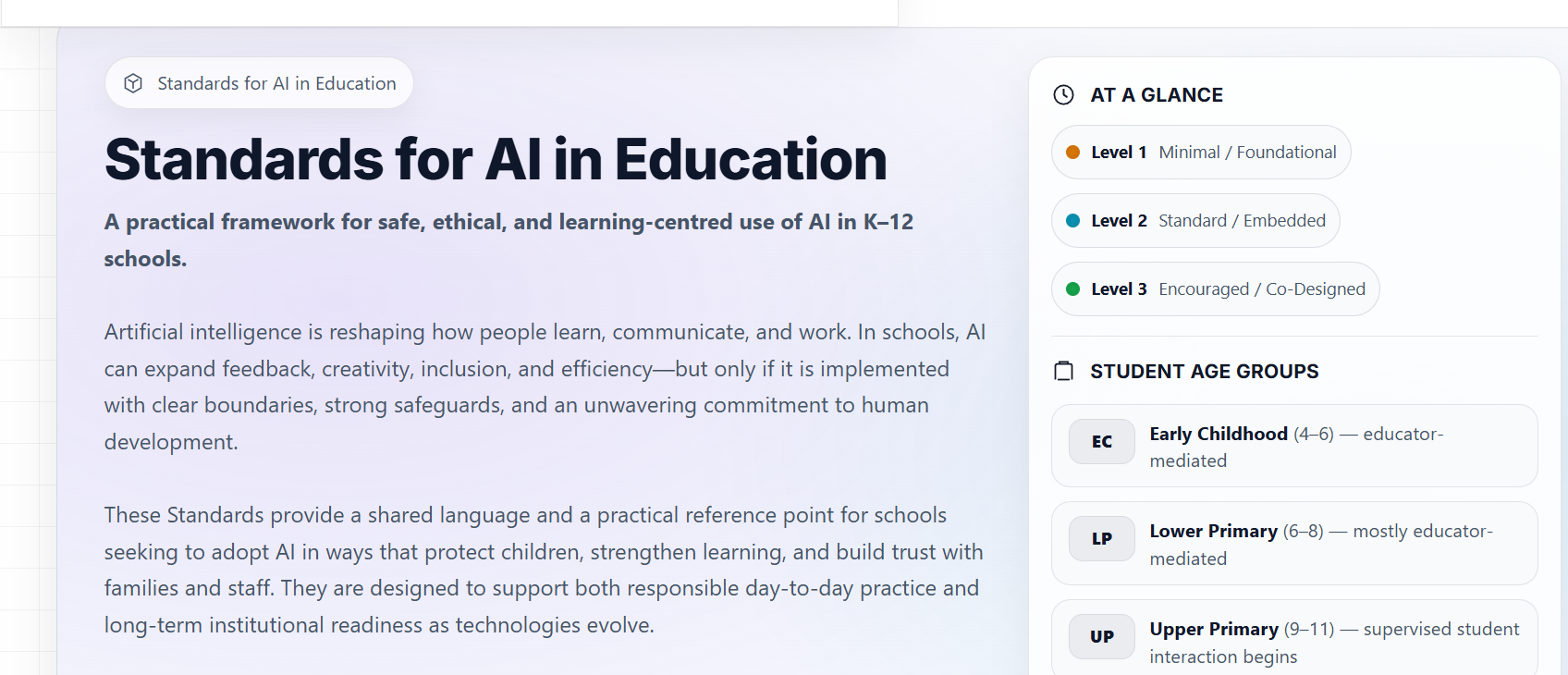
The Standards section has been created for schools that want to move beyond improvisation and toward a more thoughtful, responsible, and developmentally appropriate approach to AI. Rather than offering scattered advice or generic recommendations, it provides a clear architecture for thinking about learning, ethics, privacy, wellbeing, governance, and school-wide implementation.
This tour offers a guided introduction to that framework and a glimpse of what members can explore in full.
Why the Standards matter
Artificial intelligence is already reshaping education. Schools are now being asked to make decisions that affect not only productivity and access to information, but also authorship, human judgment, privacy, fairness, student development, and trust.
In that context, many educators and school leaders are asking similar questions. The Standards section was created to help schools answer those questions in a serious and structured way. It gives educational communities a common language, a developmental framework, and practical guidance for responsible implementation.
Questions many schools are asking
- How should students use AI, and under what conditions?
- How can schools preserve real thinking and authentic learning?
- How do we support teachers without weakening pedagogy?
- How do we communicate clearly with families?
- How do we protect privacy and create safe boundaries?
- How do we govern AI use coherently across the whole school?
A framework built for real schools
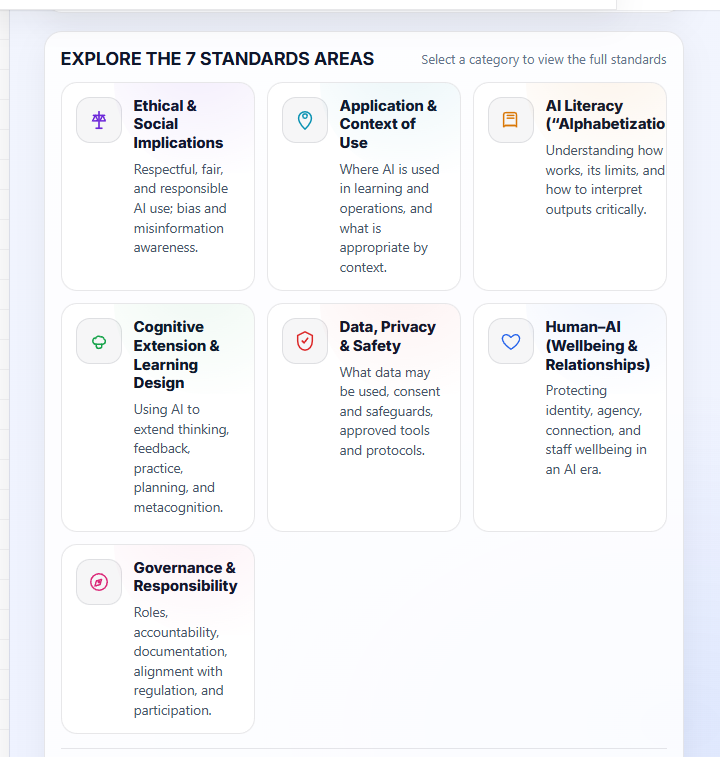
The Standards are organized into seven major areas, each addressing a key dimension of AI in education. This reveals something important about the philosophy of the Center: AI is not treated here as merely a technology issue.
It is approached as a question of pedagogy, ethics, culture, leadership, trust, child development, and institutional responsibility. That breadth is one of the defining strengths of the Standards section. It helps schools think beyond tools and begin building a coherent approach.
Ethical & Social Implications
Application & Context of Use
AI Literacy
Cognitive Extension & Learning Design
Data, Privacy & Safety
Humanity, Wellbeing & Relationships
Governance & Responsibility
Designed for the whole school community
A key feature of the Standards is that they are written for the entire educational community. Each standards area is organized around three audiences: Students, Families, and School Personnel.
The framework recognizes that responsible AI use cannot be built only in the classroom. Schools need shared expectations, shared language, and shared understanding across all parts of the community.
Students
Age-appropriate guidance, growing independence, and clear expectations.
Families
Clarity, transparency, and practical language that supports the home-school partnership.
School Personnel
Direction for teaching, leadership, operations, implementation, and accountability.
Developmental, not one-size-fits-all
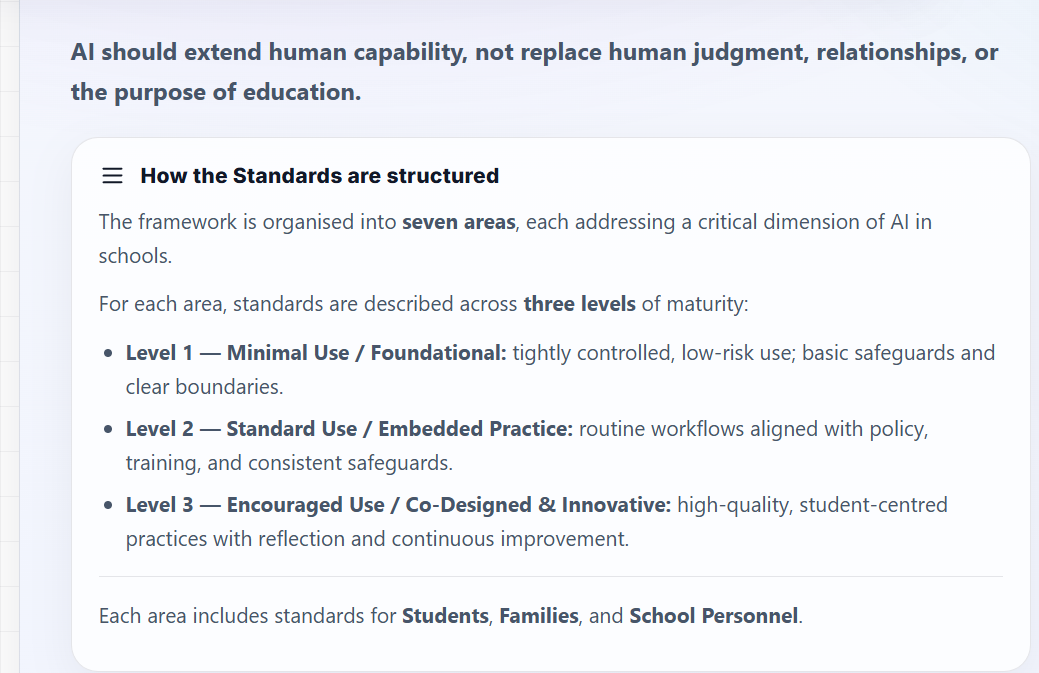
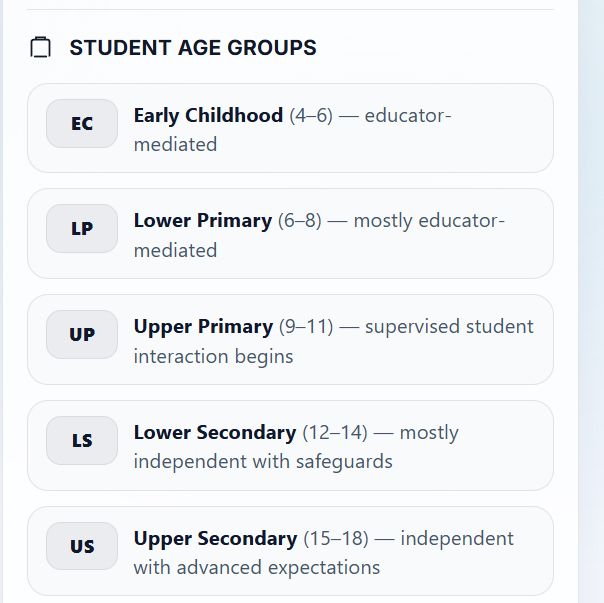
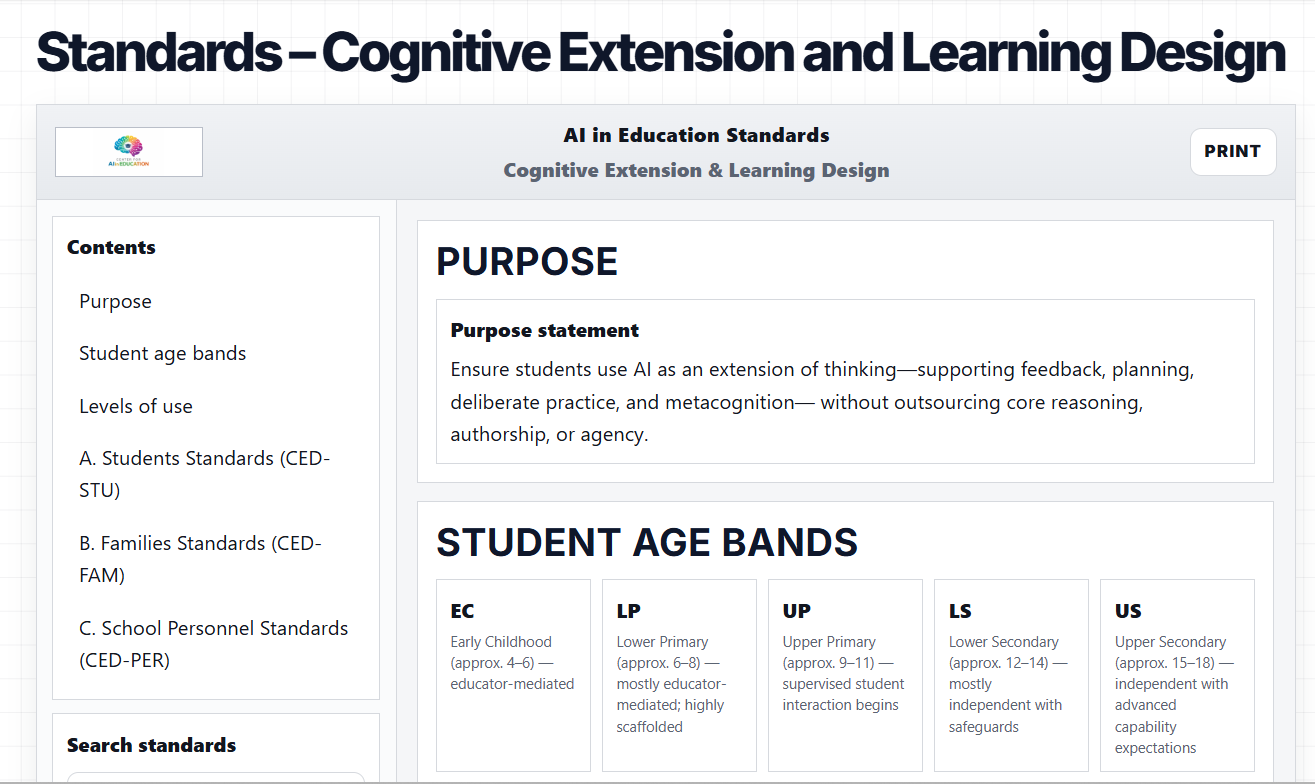
The Standards are designed around the idea that a school’s approach to AI should change with age, maturity, and context. They are structured across developmental bands, from Early Childhood through Upper Secondary, with tighter safeguards and stronger adult mediation in the younger years, and more independence and responsibility as students grow older.
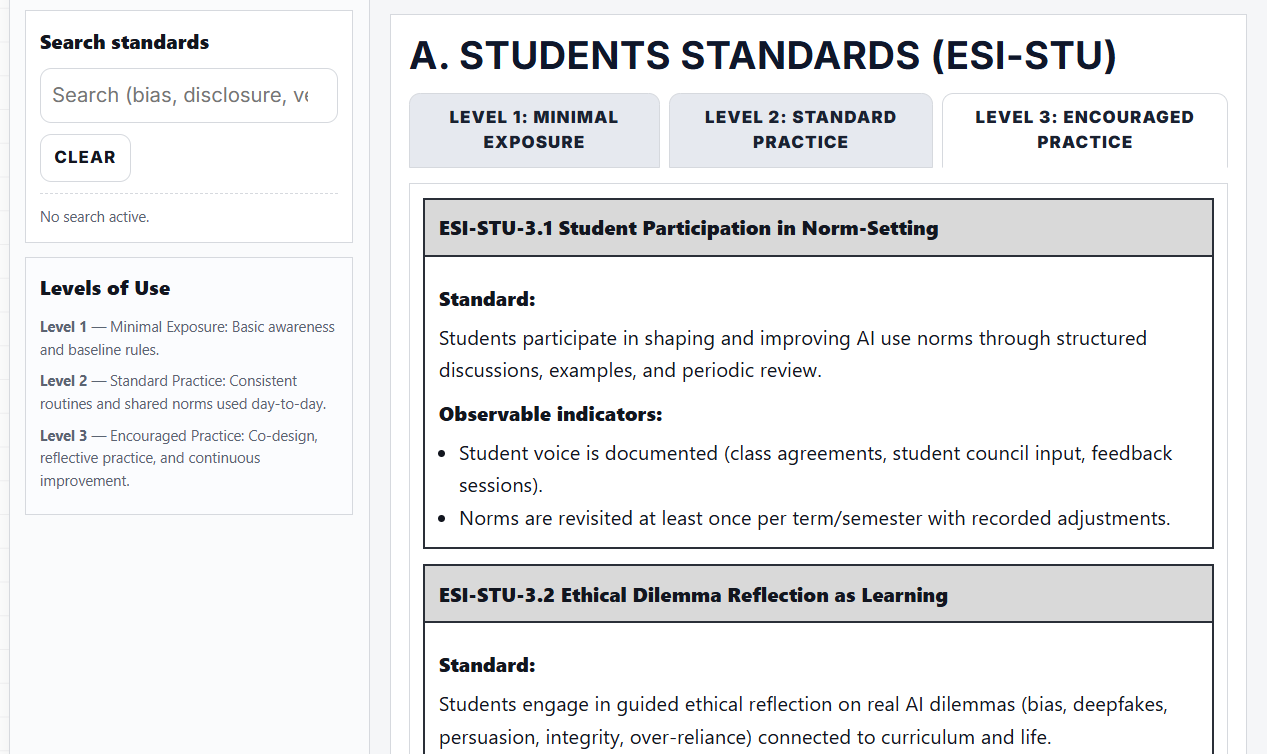
The framework also uses three levels of implementation, making it useful not only for defining expectations, but also for understanding where a school currently is and how it might evolve over time.
Level 1
Foundational, tightly controlled practice.
Level 2
More routine, embedded, school-wide use.
Level 3
Deeper reflection, participation, and mature implementation.
The core educational principle
One of the most distinctive ideas in the Standards section is the principle that AI should extend thinking, not replace it. This is central to the Center’s philosophy.
The aim is not to reject AI, nor to embrace it uncritically. Instead, the framework argues that AI can be valuable when it helps learners clarify ideas, receive feedback, practice, plan, reflect, or explore possibilities — but that it should never displace core reasoning, authorship, agency, or human judgment.
Cognitive extension, not cognitive replacement
Use AI where it strengthens learning, and establish boundaries where it risks weakening it.
What members find inside each standards area
Inside each standards area, members find a clear and highly usable structure. The pages typically begin with a statement of purpose and scope, helping users understand what that area is designed to address.
They then move into detailed standards for Students, Families, and School Personnel, often organized progressively across implementation levels.
What makes the material especially practical is that the standards are not written only as abstract statements. They are also supported by observable indicators, helping schools recognize what good practice would actually look like in visible, concrete terms.
A guided preview of the seven areas
Together, these seven areas create a comprehensive framework that is unusually broad, serious, and educationally grounded.
Ethical & Social Implications
Dignity, fairness, harm reduction, bias, respectful use, disclosure, and moral culture.
Application & Context of Use
Where and how AI may be used across classwork, homework, projects, assessment support, communication, administration, and leadership.
AI Literacy
Understanding how AI works, how it fails, and how to interpret outputs critically.
Cognitive Extension & Learning Design
Using AI to support learning without replacing reasoning, authorship, or agency.
Data, Privacy & Safety
Approved tools, consent, anonymization, safe inputs, data minimisation, and incident response.
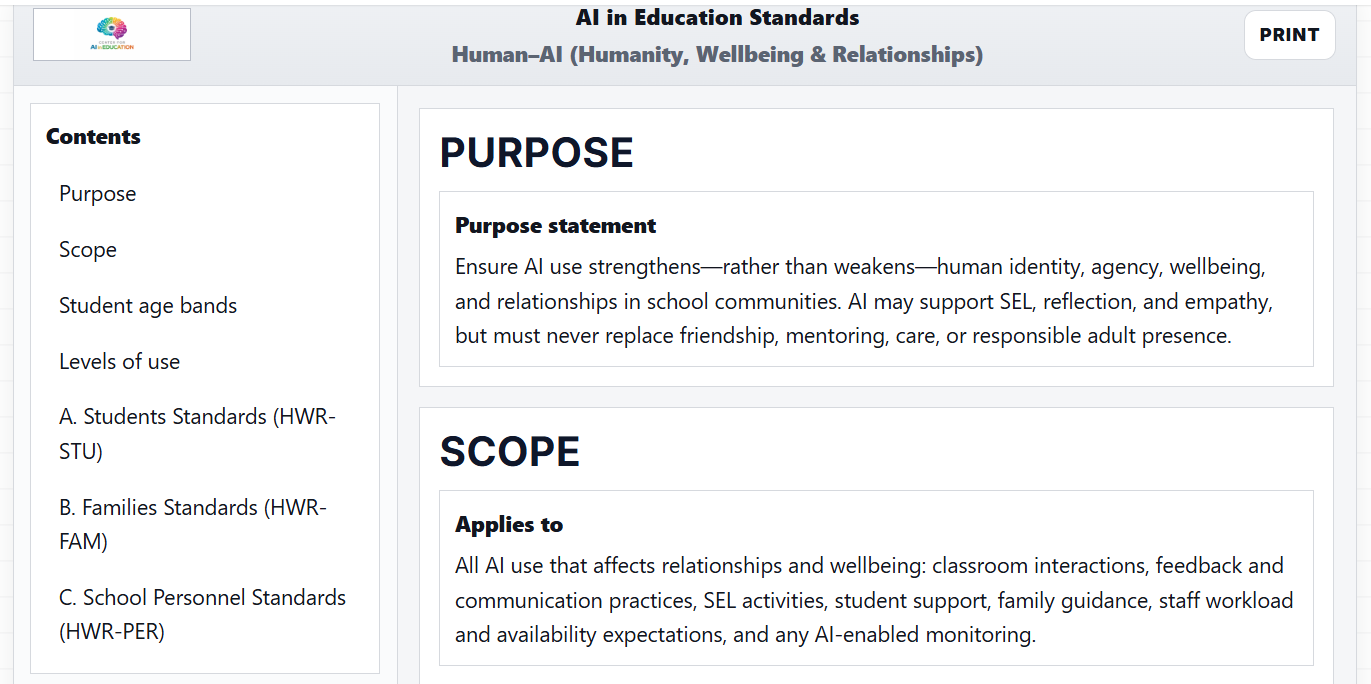
Humanity, Wellbeing & Relationships
Protecting human identity, healthy boundaries, wellbeing, and relationships.
Governance & Responsibility
Roles, accountability, documentation, participation, review processes, and school-wide coherence.
What makes this different
There is no shortage of online advice about AI in education. But much of it is fragmented, reactive, tool-driven, or overly generic.
What makes the Standards section different is its depth and coherence. It is grounded in educational purpose and treats AI as something that affects cognition, authorship, fairness, relationships, culture, leadership, and institutional trust.
It is also clearly written for real-world use. Schools can use the framework to support policy development, teacher guidance, family communication, classroom design, leadership decisions, and longer-term review.
Who this is for
The Standards section is especially valuable for those who understand that AI in education cannot be handled well through improvisation alone.
AI is already transforming education. The real question is how thoughtfully schools will respond.
The Standards section of the Center for AI in Education has been created to help schools respond with clarity, coherence, and wisdom — protecting learning, preserving humanity, and building a responsible path forward.
The section helps schools move from uncertainty to clarity, from isolated decisions to shared frameworks, and from enthusiasm or fear to responsible implementation.
For those who want to engage seriously with AI in education, full access offers something increasingly rare: depth, coherence, and direction.