AI Uses Energy Too:
Digital Tools Are Connected to the Real World
Two Grade 2 lessons that help students understand the hidden journey behind an AI question and practice using AI just enough, with purpose and continued thinking.
Big idea for Grade 2
Digital tools are connected to the real world. When we use AI, energy is used somewhere — so we use it thoughtfully.
Classroom message
AI can help, but I am the thinker. I ask wisely and use just enough.
Building early systems thinking about AI and energy
This Grade 2 mini-unit helps students understand that AI does not work “by magic.” It depends on computers, electricity, and systems beyond the screen.
Students begin to connect digital actions with real-world energy use and practice deciding when AI use is useful, purposeful, and not wasteful.
Lesson 1: The Hidden Journey of an AI Question
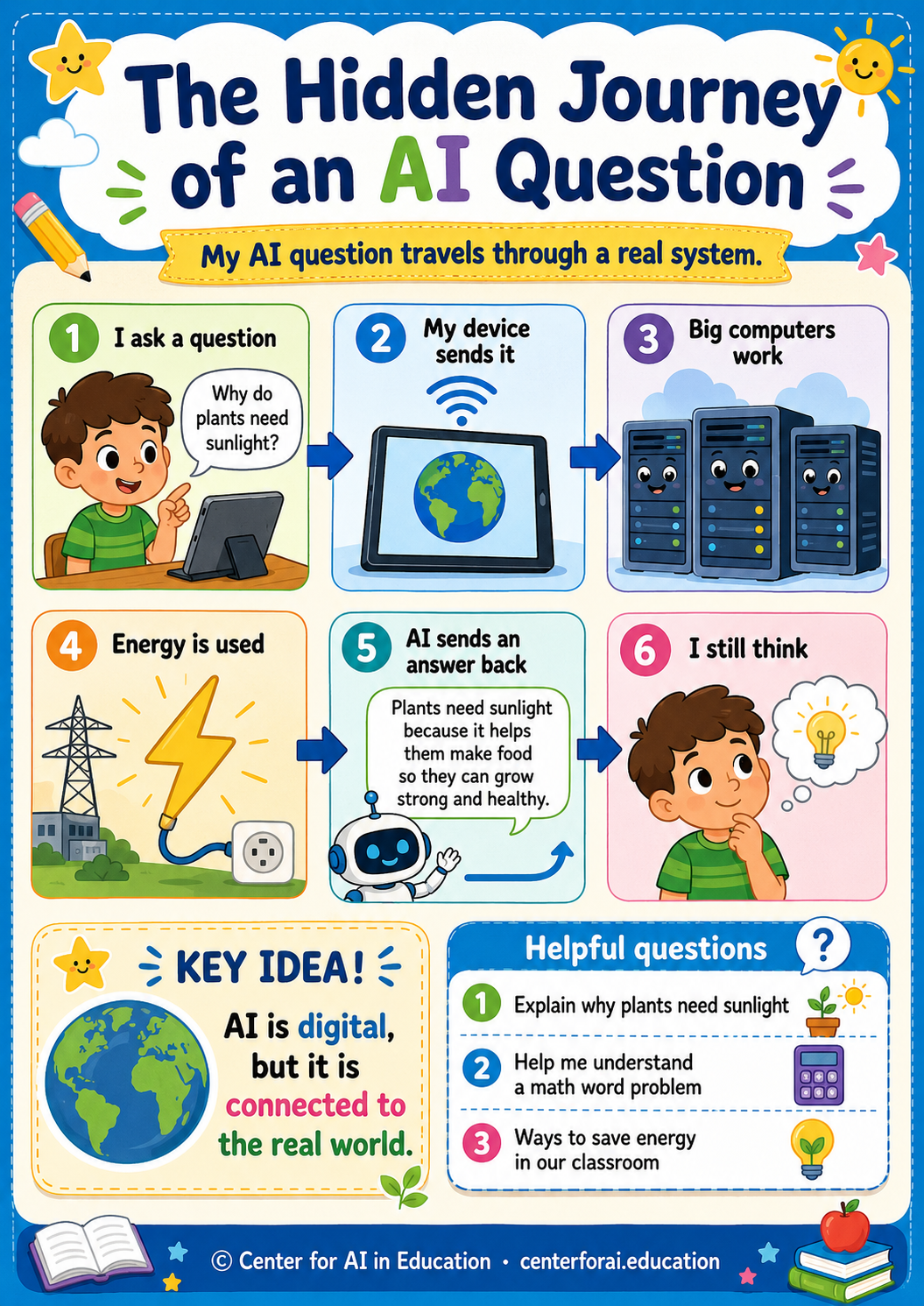
Students understand that when they ask AI a question, computers work, electricity is used, and an answer comes back.
Learning goal
Students understand that an AI answer comes from a real system beyond the screen.
Key message
My AI question travels through a real system.
Duration
35–40 minutes.
Materials
Chart paper, markers, crayons, paper, optional string or arrows, and picture cards.
Simple mental model
The hidden journey
When we ask AI a question, the answer does not come from nowhere. The question travels through computers and networks. Machines work to make the answer, and those machines need electricity.
Lesson flow
- 1Opening question: Ask students where they think an AI answer comes from.
- 2Act it out: Students role-play the journey of a prompt from question to answer.
- 3Draw the journey: Students create a simple flow map with arrows and icons.
- 4Discuss useful questions: Compare helpful AI questions with repeated or unnecessary uses.
- 5Exit ticket: Students complete: “When I ask AI a question, ______.”
Student sentence stem
When I ask AI a question, __________.
Simple assessment
- ✓Students can say that AI answers come from computers working.
- ✓Students can say that computers need electricity.
- ✓Students can draw or describe the journey of an AI question.
Lesson 2: Use Just Enough — Smart AI Choices
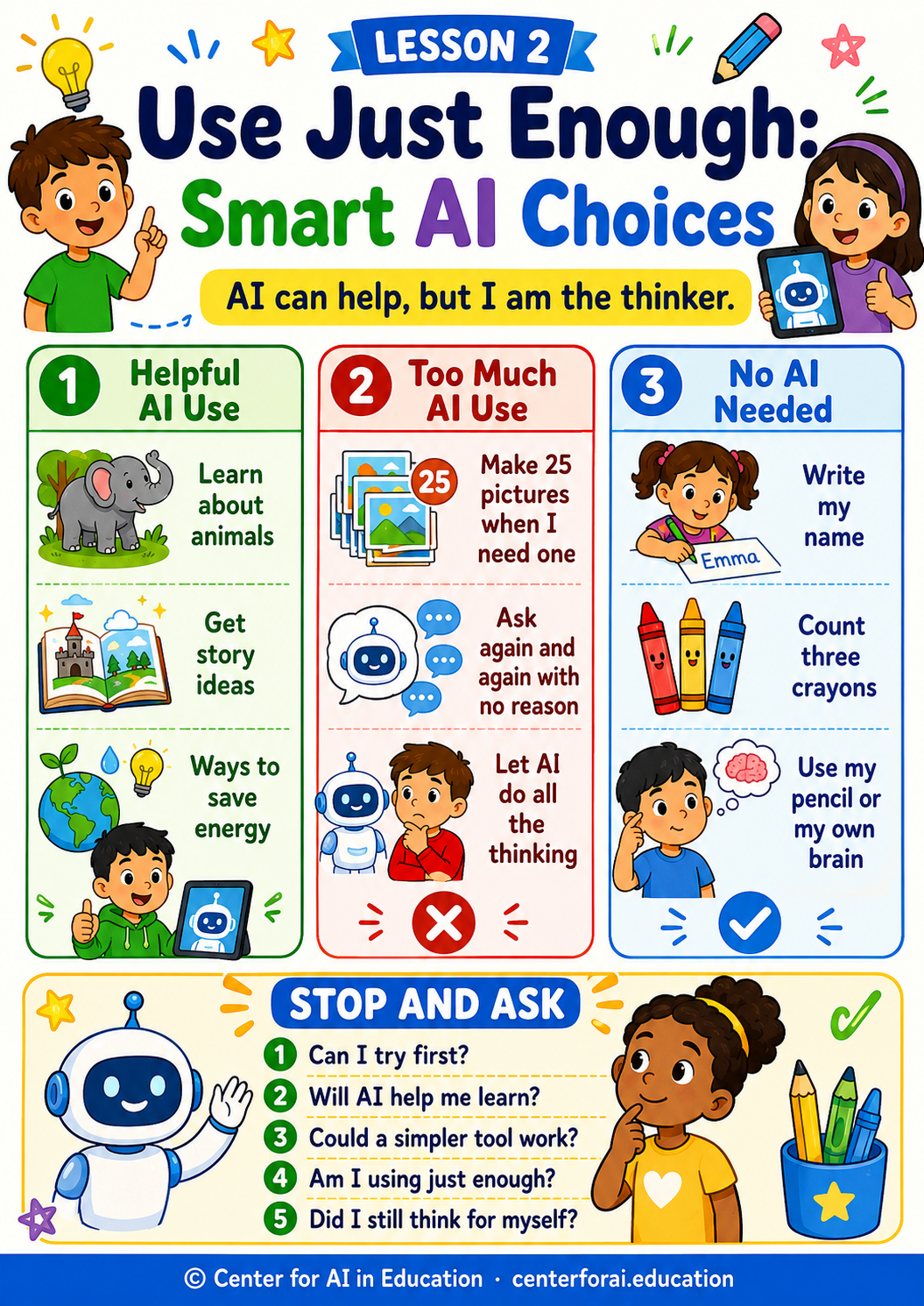
Students compare AI uses and decide whether they are helpful, too much, or not needed.
Learning goal
Students learn to compare AI uses and decide when AI is useful, too much, or not needed.
Key message
Use AI when it helps. Use just enough. Keep thinking.
Duration
35–40 minutes.
Materials
Board or chart paper, scenario cards, three category signs, crayons, paper, and sticky notes.
Three smart choices
Smart AI use is a choice
Smart AI use is not “always use it” or “never use it.” Smart AI use means choosing carefully.
Lesson flow
- 1Review: Ask what happens when we ask AI a question.
- 2Introduce the three choices: Helpful AI Use, Too Much AI Use, and No AI Needed.
- 3Scenario sorting: Students sort examples into the three categories.
- 4Stop and Ask: Teach students the “use just enough” decision routine.
- 5Smart AI Choice card: Students create a small card or mini-poster.
Student sentence stems
I can use AI to __________.
I do not need AI when __________.
I use just enough by __________.
Simple assessment
- ✓Students can sort AI uses into helpful, too much, and no AI needed.
- ✓Students can explain one reason why an AI use is helpful.
- ✓Students can identify one situation where AI is not needed.
Use Just Enough
AI can help, but I am the thinker.
For Grade 2, the key idea is early systems thinking.
Students begin to understand that digital actions have a hidden journey. When they ask AI a question, computers work, energy is used, an answer comes back, and the student still needs to think.
The main habit is “use just enough”: students learn that responsible AI use depends on purpose, proportion, and continued human thinking.