
AI Uses Energy Too:
Footprint, Value, and Responsible Use
Two Grade 5 lessons that help students understand AI’s environmental footprint and evaluate when AI use creates enough value to justify the resources involved.
Big idea for Grade 5
AI has an environmental footprint. Responsible users investigate what resources are involved and decide when AI use creates enough value to justify that footprint.
Classroom message
Use AI when the value is worthy of the footprint.
Helping students understand AI’s environmental footprint
This Grade 5 mini-unit introduces environmental footprint in a concrete and accessible way. Students learn that AI depends on real resources: electricity, computers, networks, cooling, water, materials, and human decisions.
Students do not need advanced technical detail, but they should begin to distinguish between different kinds of environmental impact and evaluate whether a use of AI is meaningful, necessary, and proportional.
Lesson 1: What Is the Footprint of AI?
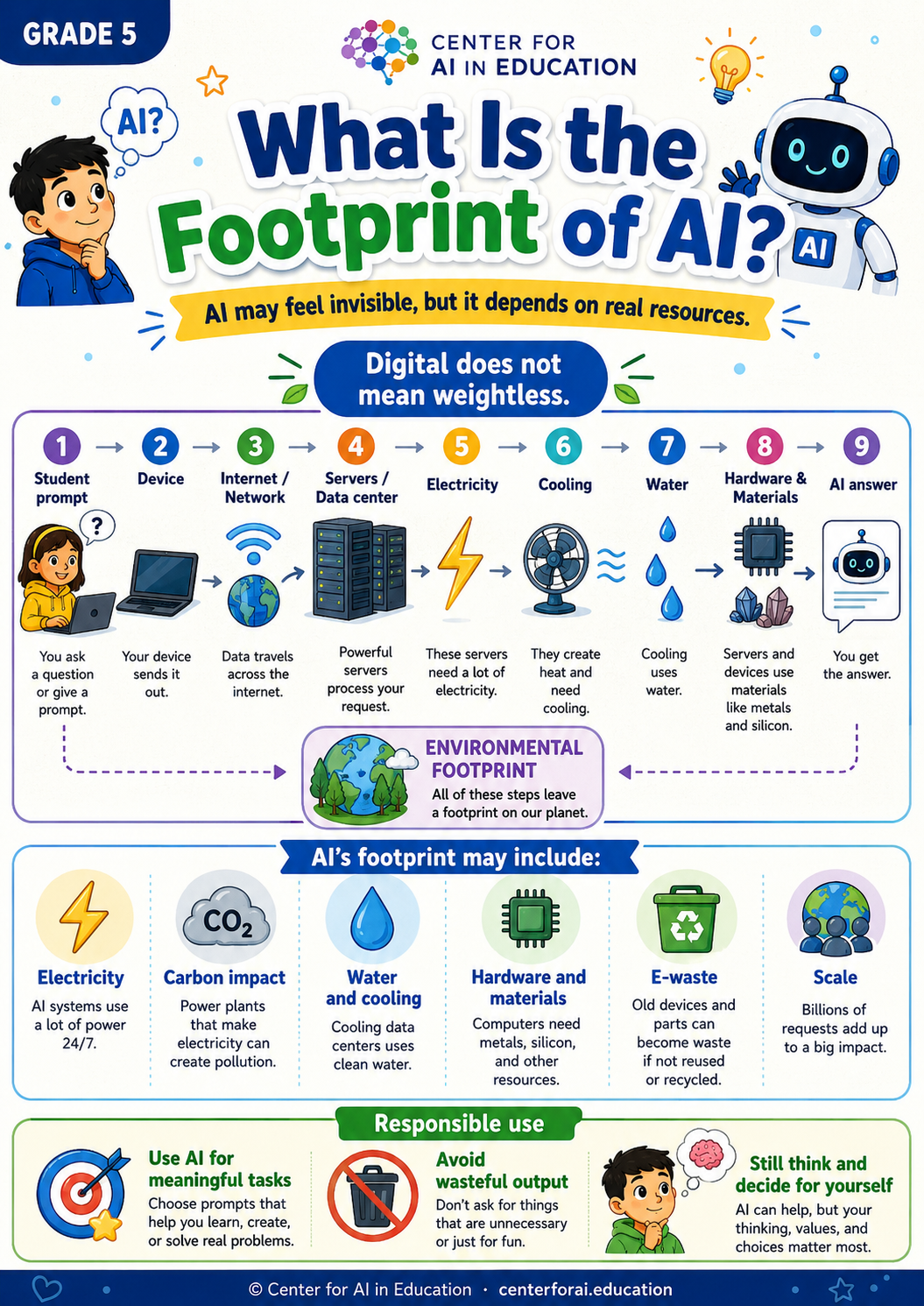
Students understand that AI has an environmental footprint because it depends on electricity, hardware, data centers, cooling, water, materials, and networks.
Learning goal
Students understand that AI depends on real resources and leaves an environmental footprint.
Key message
AI may feel invisible, but it depends on real resources.
Duration
45 minutes.
Materials
Board or chart paper, markers, student worksheet or paper, pencils, sticky notes, and optional picture cards.
Digital does not mean weightless
AI’s footprint may include:
An environmental footprint means the effect something has on the environment. AI has a footprint because it uses real systems and resources.
Lesson flow
- 1Opening question: Ask students what resources might be involved when we use AI.
- 2Introduce footprint: Explain environmental footprint as the effect something has on the environment.
- 3Resource matching: Students match AI-related resources to what they do in the system.
- 4Footprint map: Students create a visual map titled “The Footprint Behind an AI Answer.”
- 5Balanced discussion: Ask whether AI is always bad for the environment if it has a footprint.
- 6Exit ticket: Students identify hidden resources and explain responsible AI use.
Resource matching examples
| Resource | What it does |
|---|---|
| Electricity | Powers computers and networks. |
| Servers | Process AI questions and generate answers. |
| Cooling | Helps machines avoid overheating. |
| Materials | Used to make chips, devices, cables, and batteries. |
Student sentence stems
One hidden resource used by AI is __________.
AI has a footprint because __________.
A responsible AI use is one that __________.
Simple assessment
- ✓Students can explain what an environmental footprint means.
- ✓Students can identify several resources involved in AI use.
- ✓Students can explain why AI should be used purposefully.
Lesson 2: Footprint vs. Value — When Is AI Worth Using?
Students evaluate AI uses by comparing environmental footprint, learning value, purpose, alternatives, and possible positive impact.
Learning goal
Students evaluate AI uses by comparing footprint, value, purpose, alternatives, and impact.
Key message
A responsible AI use creates enough value to justify the resources it uses.
Duration
45 minutes.
Materials
Board or chart paper, markers, scenario cards, student worksheet or paper, pencils, and optional colored dots or sticky notes.
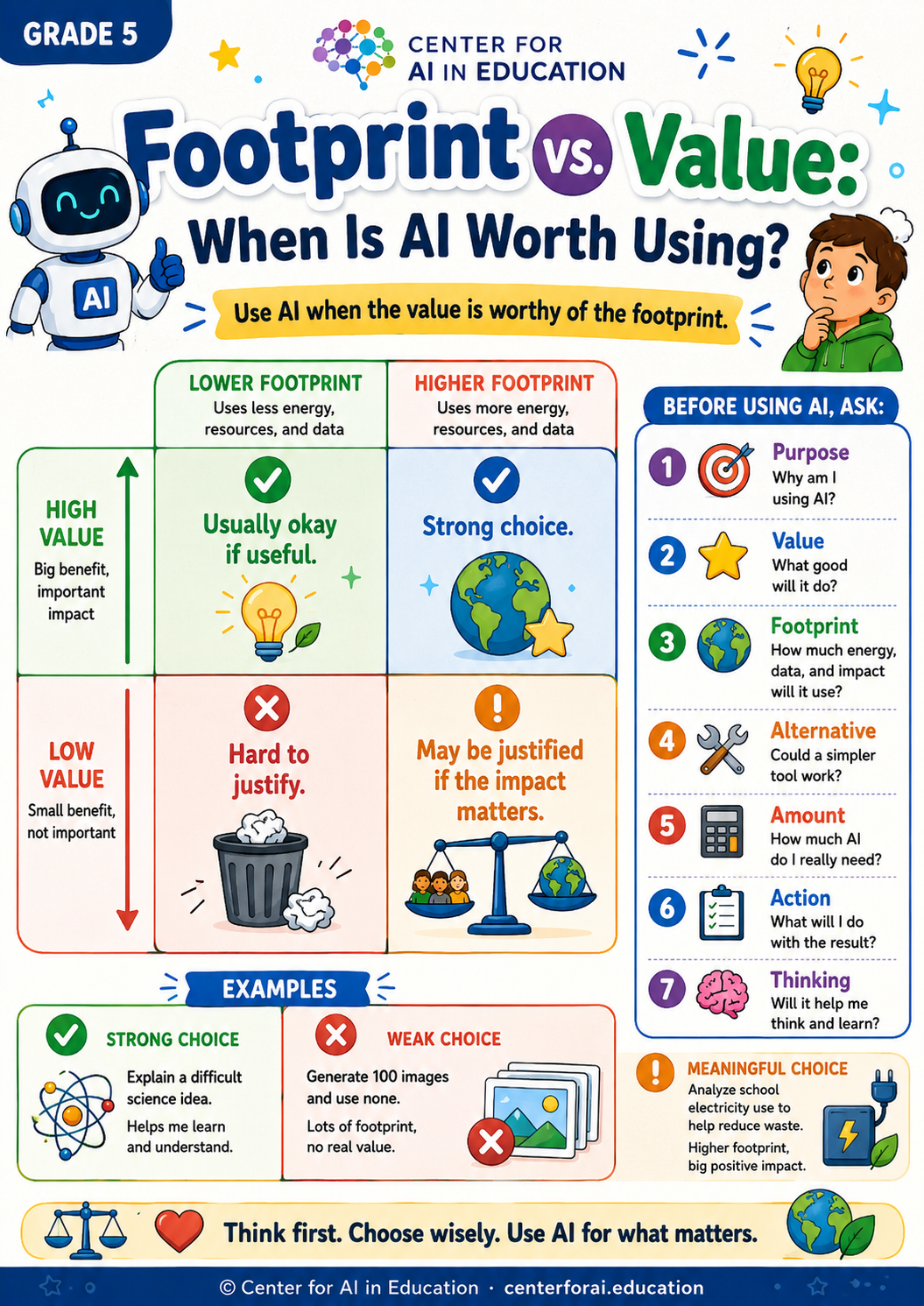
The Footprint-Value Matrix
Compare footprint and value.
Students may not know the exact footprint of every AI use, but they can still compare whether the task is simple or complex, whether the purpose is important, and whether a simpler tool could work.
Lesson flow
- 1Review: Students recall resources involved in AI use.
- 2Introduce the matrix: Compare footprint and value using simple examples.
- 3Scenario ranking: Students place AI uses on the footprint-value matrix.
- 4Whole-class discussion: Discuss whether the value of each use justifies the resources involved.
- 5Redesign challenge: Students redesign a questionable AI use into a more responsible one.
- 6Reflection: Students complete sentence stems about when AI is worth using.
Example scenarios
| Scenario | Likely judgment |
|---|---|
| I ask AI for a short explanation of a math concept I do not understand. | Responsible if it helps learning and the student still thinks. |
| I ask AI to generate 60 images for fun and delete them. | Weak value and unnecessary output. |
| I ask AI to help compare two ways our school could save electricity. | Potentially high value because it may reduce larger waste. |
| I ask AI to write my full essay and submit it without reading it. | Low learning value and weak responsibility. |
Student sentence stems
AI is worth using when __________.
AI is not worth using when __________.
A simpler tool might be better when __________.
I can reduce digital waste by __________.
Simple assessment
- ✓Students can compare footprint and value in a simple way.
- ✓Students can classify AI uses as responsible, questionable, or not responsible.
- ✓Students can redesign a weak AI use into a more responsible one.
Footprint vs. Value
Use AI when the value is worthy of the footprint.
For Grade 5, the key idea is footprint awareness.
Students can begin to understand that AI uses physical resources, but they should not be overwhelmed by technical detail or guilt. The core habit is to compare footprint and value.
This prepares students for later work on energy sources, carbon impact, data centers, water use, hardware, efficiency, and the role of AI in environmental solutions.