
AI Uses Energy Too:
Energy Sources, Carbon Impact, and Scale
Two Grade 6 lessons that help students distinguish energy use from carbon impact and understand how small AI actions become large systems when repeated at scale.
Big idea for Grade 6
The environmental impact of AI depends not only on how much energy it uses, but also on where that energy comes from, how often AI is used, and whether the use creates meaningful value.
Classroom message
Think beyond the prompt. Consider the system, the source of energy, and the scale of use.
Helping students connect AI use with energy systems and scale
This Grade 6 mini-unit deepens students’ understanding of AI’s environmental footprint by distinguishing between energy use and carbon impact.
Students learn that the same AI task may have different environmental consequences depending on the electricity source, the efficiency of the system, the type of task, and the scale of use.
Lesson 1: Energy Use vs. Carbon Impact
Students understand that AI uses energy, but its carbon impact depends partly on how that energy is produced.
Learning goal
Students distinguish between energy use and carbon impact in AI systems.
Key message
Energy use and carbon impact are connected, but they are not the same thing.
Duration
45–50 minutes.
Materials
Board or chart paper, markers, student worksheet or paper, pencils, sticky notes, and optional energy source cards.
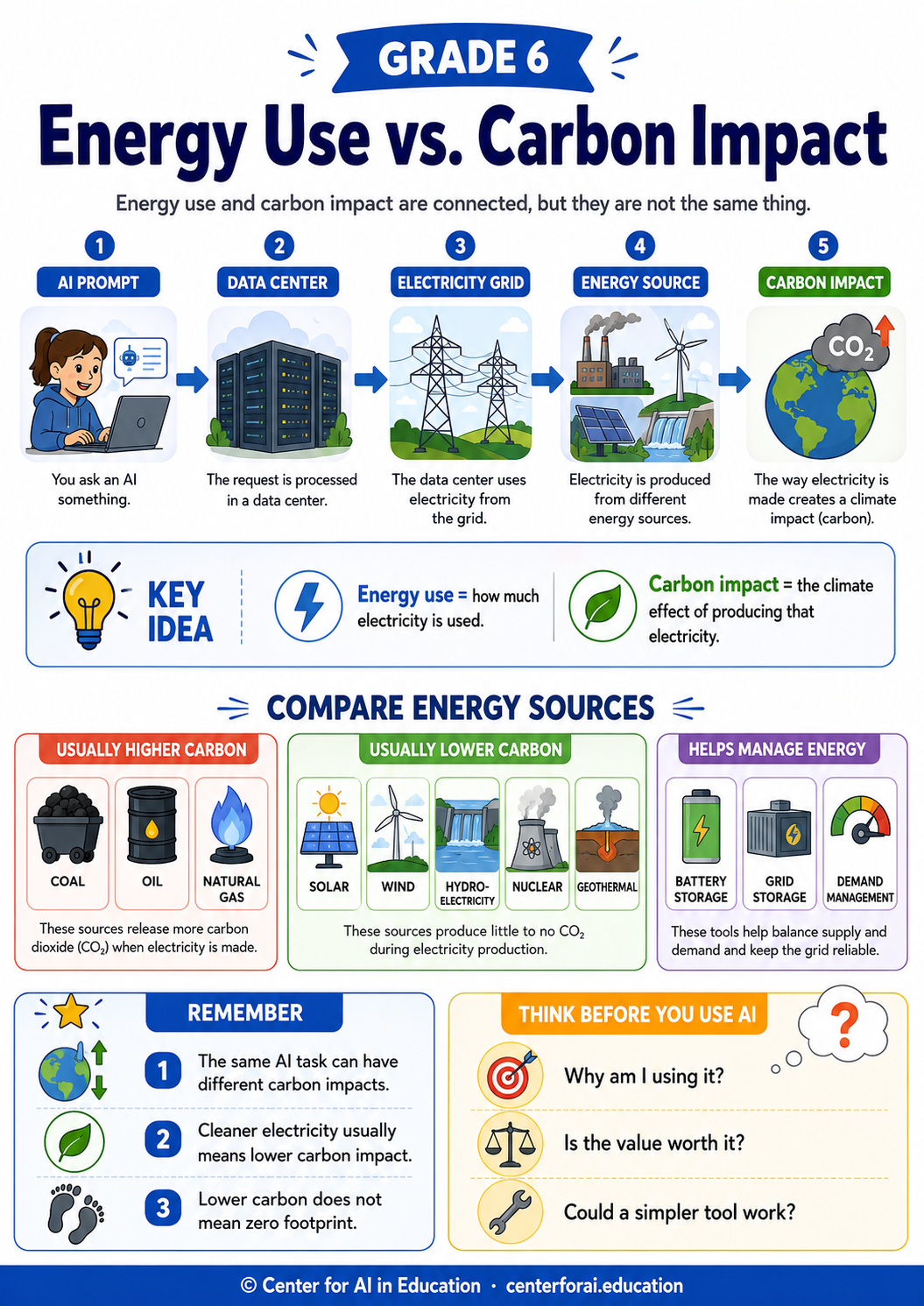
The energy chain
From AI prompt to carbon impact
Energy use tells us how much electricity is used. Carbon impact tells us how much greenhouse gas pollution may be created because of producing that electricity.
Lesson flow
- 1Opening question: Ask whether two computers using the same electricity always create the same carbon impact.
- 2Build the energy chain: Connect AI prompt, data center, grid, energy source, and carbon impact.
- 3Energy source sorting: Students sort energy sources by usually higher carbon, usually lower carbon, and energy management.
- 4Compare scenarios: Students compare data centers powered by different energy mixes and different AI uses.
- 5Mini-diagram: Students create “From AI Prompt to Carbon Impact.”
- 6Exit ticket: Students explain the difference between energy use and carbon impact.
Energy source sorting
| Usually higher carbon | Usually lower carbon | Helps manage energy |
|---|---|---|
| Coal, oil, natural gas | Solar, wind, hydroelectricity, nuclear, geothermal | Battery storage, grid storage, demand management |
Student sentence stems
Energy use means __________.
Carbon impact means __________.
AI can have different carbon impacts because __________.
A responsible AI user should __________.
Simple assessment
- ✓Students can distinguish between energy use and carbon impact.
- ✓Students can explain why electricity sources matter.
- ✓Students can describe the chain from AI prompt to carbon impact.
Lesson 2: Scale — When Small Uses Become Big Systems
Students understand that a single AI use may seem small, but repeated use by many people can create significant energy, infrastructure, and environmental demand.
Learning goal
Students understand that small AI actions can become large impacts when repeated by many people over time.
Key message
Scale matters: small digital actions can become large impacts when millions of people repeat them.
Duration
45–50 minutes.
Materials
Board or chart paper, markers, student worksheet or paper, pencils, sticky notes, optional counters, and scenario cards.
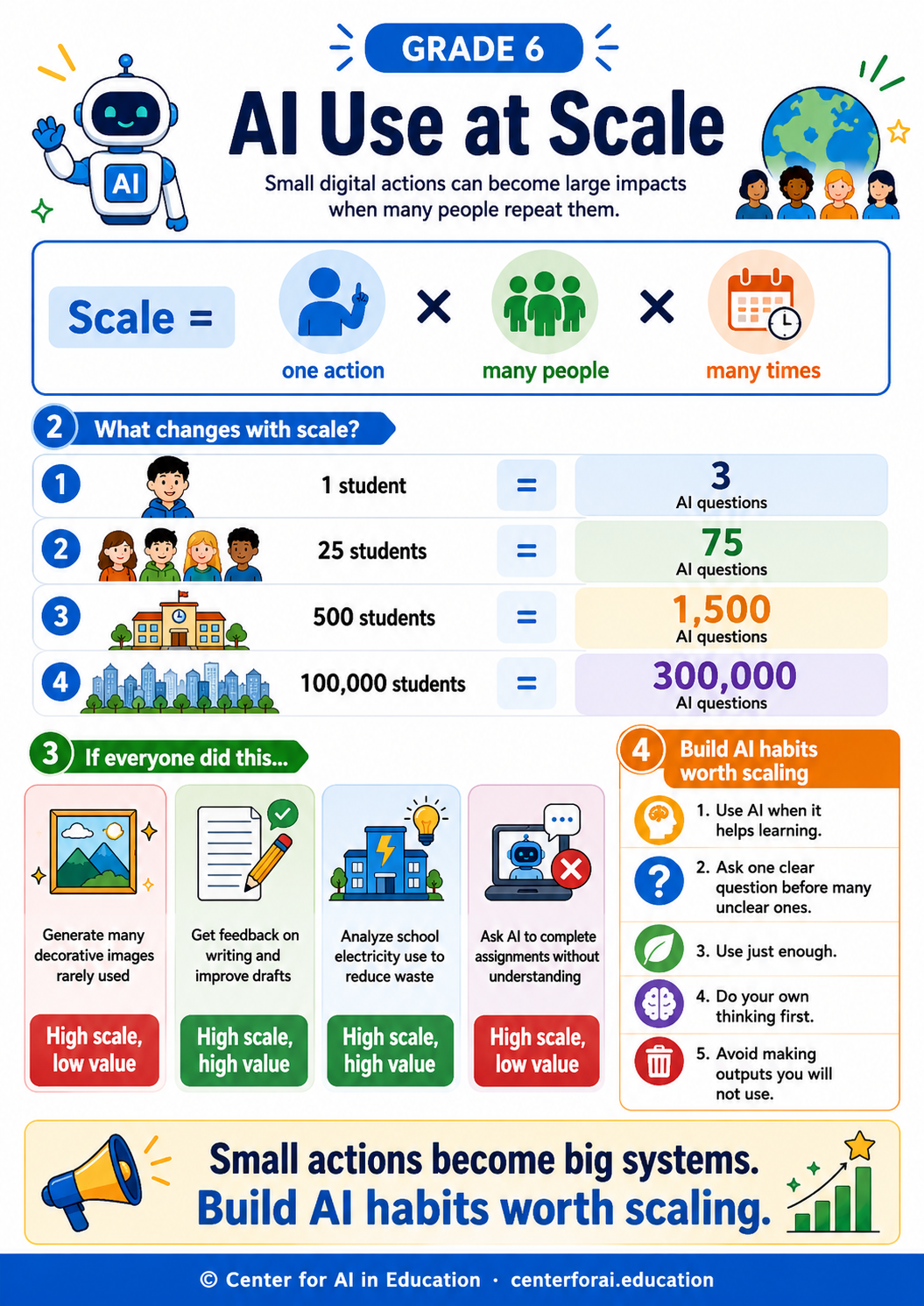
Scale formula
Small actions can become big systems.
Scale means how large something becomes when it is multiplied across people, places, and time.
Lesson flow
- 1Opening question: Ask whether one AI question is a big environmental problem.
- 2Everyday scale examples: Compare one plastic bottle, one light left on, or one car trip with large repeated patterns.
- 3AI scale simulation: Students calculate how AI questions multiply across a class, school, or city.
- 4Scale and value comparison: Students evaluate school-wide AI uses by asking whether impact and value grow together.
- 5Create a rule: Students write a scale-aware AI rule for the class or school.
- 6Closing discussion: Students discuss why habits matter more than one isolated prompt.
AI scale simulation
| Group | If each asks 3 AI questions | If each asks 30 AI questions |
|---|---|---|
| 1 student | 3 questions | 30 questions |
| 25 students | 75 questions | 750 questions |
| 500 students | 1,500 questions | 15,000 questions |
| 100,000 students | 300,000 questions | 3,000,000 questions |
Student sentence stems
If everyone used AI this way, __________.
A scale-aware AI rule for our class is __________ because __________.
Small actions become big systems when __________.
Simple assessment
- ✓Students can explain what scale means.
- ✓Students can reason how repeated AI use grows across groups.
- ✓Students can distinguish between high-value and low-value uses at scale.
AI Use at Scale
Small actions become big systems. Build AI habits worth scaling.
For Grade 6, the key ideas are energy source and scale.
Students are ready to distinguish energy use from carbon impact and to reason about scale. They should understand that AI’s environmental effect is not determined only by one prompt.
It depends on energy sources, infrastructure, task type, habits, and repeated use across many people. This prepares students for more advanced discussions about data centers, carbon intensity, renewable energy, efficiency, rebound effects, and AI as both an environmental challenge and a possible environmental tool.