AI Uses Energy Too:
Smart Tools, Smart Hearts
Two simple Kindergarten lessons that introduce children to energy, technology, AI as a helper, and early habits of care and responsibility.
Big idea for young children
AI is a helper, but helpers need energy. We use AI and technology when they help us learn, create, or care.
Classroom message
AI is a helper. Energy is precious. We use smart tools with smart hearts.
Introducing AI and energy without fear or technical complexity
This Kindergarten mini-unit helps children understand that technology is connected to the real world. Lights, tablets, computers, fans, and AI tools need energy to work.
The goal is not to create worry. The goal is to build simple habits of care: use tools when they help, use just enough, and turn things off when we are done.
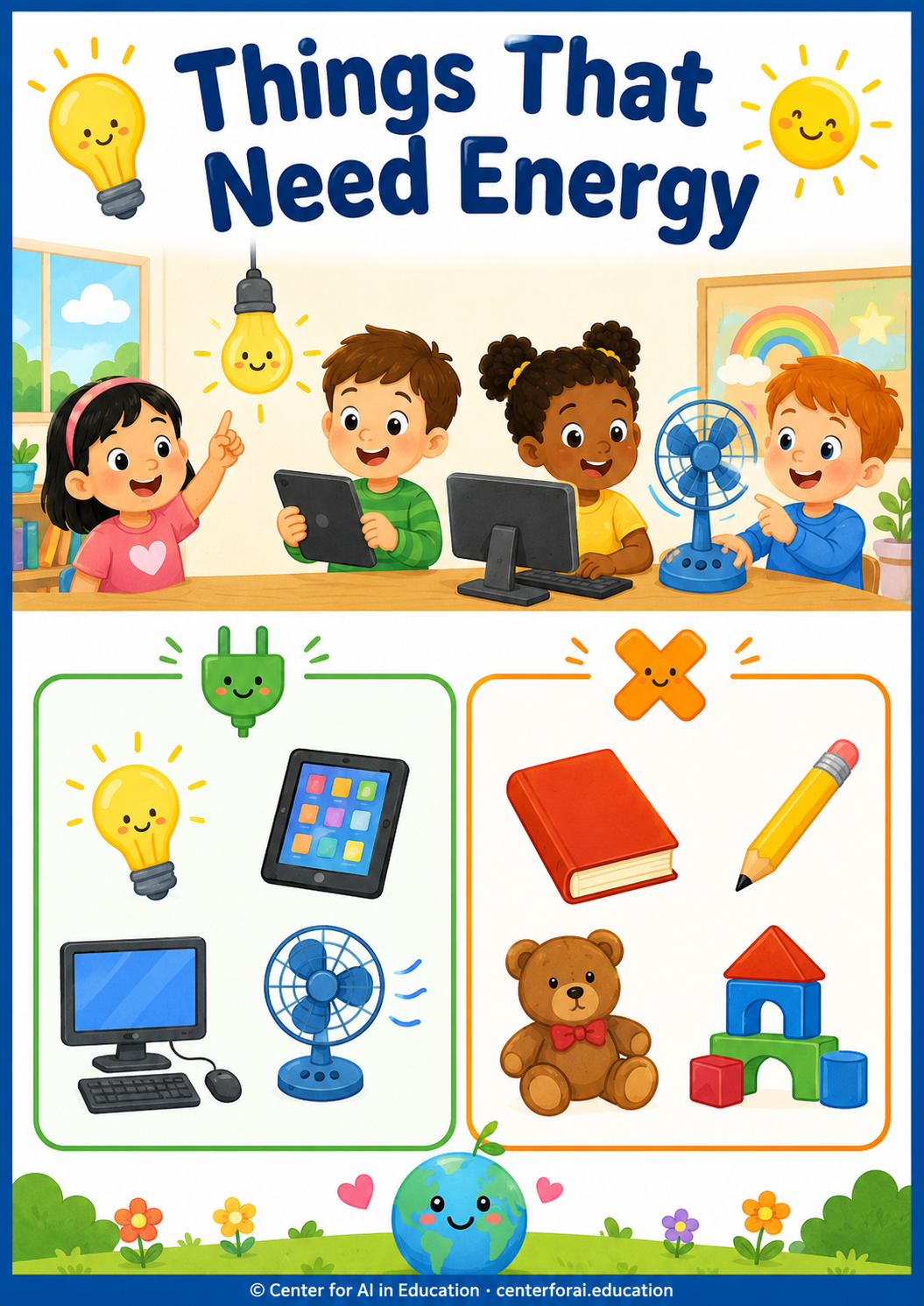
Lesson 1: Things That Need Energy
Children identify familiar objects that need energy and begin to understand that energy should be used carefully.
Learning goal
Children identify familiar objects that need energy to work.
Key message
Energy helps things work. We use energy carefully.
Duration
30–35 minutes.
Materials
Chart paper, picture cards or classroom objects, crayons, paper, and sticky notes if available.
Lesson flow
- 1Opening circle: Ask children what things in the classroom turn on.
- 2Energy Hunt: Walk around the classroom and find objects that need energy.
- 3Sort together: Place objects into “needs energy” and “does not need energy.”
- 4Movement game: Pretend to press an “on” button when an object needs energy.
- 5Drawing activity: Draw one thing that needs energy and one way to use it carefully.
Student sentence stem
I can save energy by __________.
Simple assessment
- ✓Children can name one object that needs energy.
- ✓Children can identify one object that does not need energy.
- ✓Children can say one way to avoid wasting energy.
Lesson 2: AI Is a Helper That Needs Energy
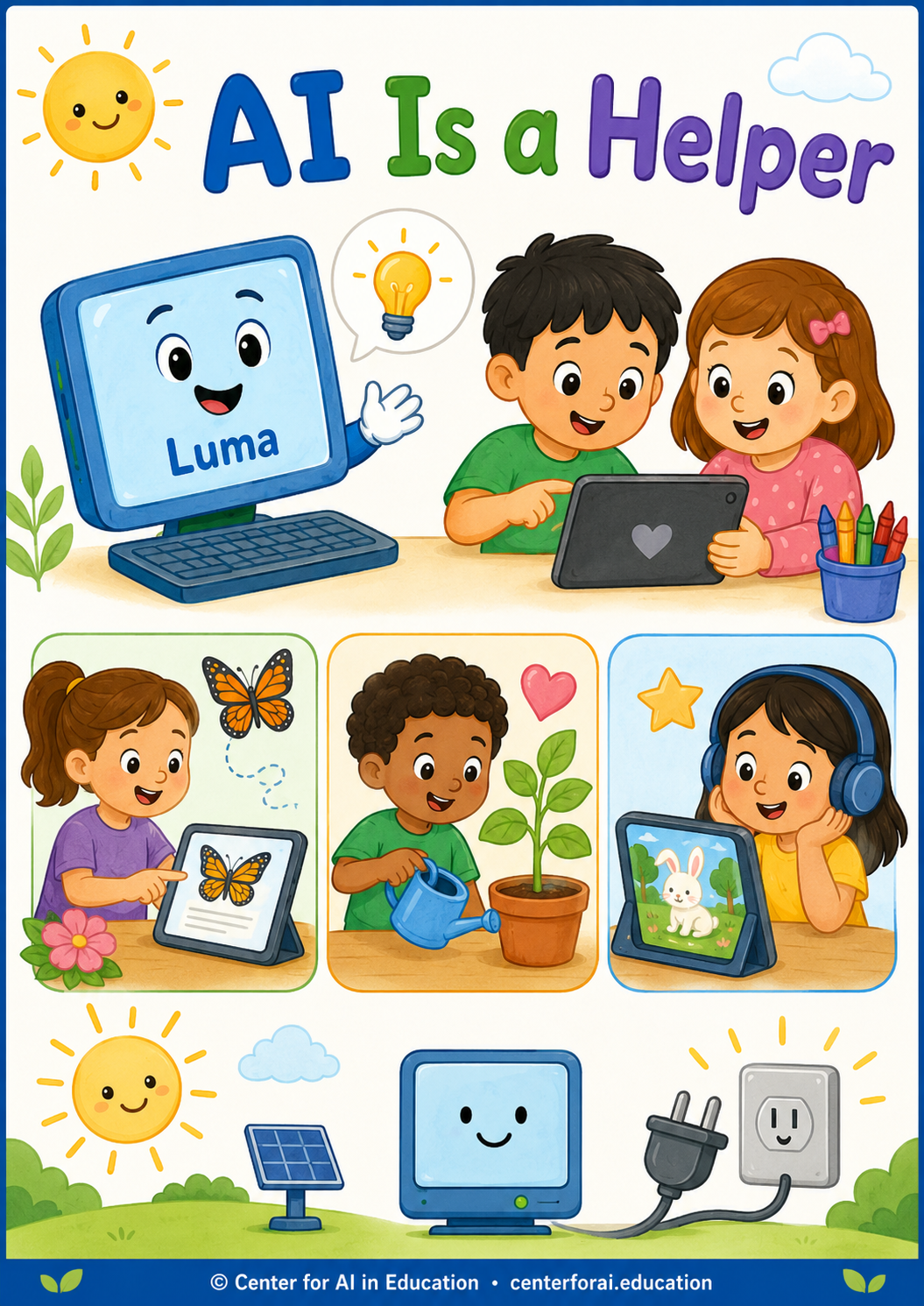
Children understand that AI can help people learn and create, but it is not magic. AI works through computers, and computers need energy.
Learning goal
Children understand that AI is a computer helper that needs energy.
Key message
AI is a helper. We use it when it helps us learn.
Duration
30–35 minutes.
Materials
Story text, board or chart paper, crayons, paper, and optional teacher computer or tablet.
Story: The Little Computer Helper
Luma, the helper
Luma is a little computer helper who loves helping children learn. Luma can help answer questions, tell stories, and give ideas.
But every time Luma helps, computers have to work. Those computers need energy. The children learn to ask: “Do we need this? Will this help us learn? Can we use just enough?”
Lesson flow
- 1Warm-up: Talk about helpers at school and tools that help us.
- 2Story: Read or tell “The Little Computer Helper.”
- 3Discussion: Ask whether Luma is magic and what Luma needs to work.
- 4Good reason or not? Children decide which AI uses help us learn or care.
- 5Drawing activity: Draw one good way AI could help us learn or care for the Earth.
Student sentence stem
AI can help me __________.
Simple assessment
- ✓Children can say that AI is a computer helper.
- ✓Children can say that computers need energy.
- ✓Children can name one helpful use of AI.
Smart Tools, Smart Hearts
We use AI to learn. We use just enough. We still think for ourselves.
For Kindergarten, the goal is early care and responsibility.
Children do not need technical explanations about AI infrastructure. They need simple, concrete ideas: some things need energy, energy should not be wasted, AI is a computer helper, and smart tools should be used for good reasons.
The learning goal is to build early habits of thoughtful technology use: use tools when they help, use just enough, and remember that people still think, choose, and care.